The Vintage Motorcycles
Specialists in antique, classic, veteran and vintage motorcycles.
Specialists in antique, classic, veteran and vintage motorcycles.
A museum-grade collection of Excelsior motorcycles, representing one of the earliest large-scale manufacturing efforts in American motorcycling. From robust V-twin engineering to endurance racing machines and integrated production systems, each motorcycle reflects the intersection of industrial expansion, mechanical reliability, and early twentieth-century mobility.
Curated by international vintage motorcycle specialists. Each Excelsior motorcycle is selected based on historical significance, engineering authenticity, and preservation quality suitable for private collections, museums, and long-term investment portfolios.
Excelsior Motorcycle emerged in the early twentieth century as one of the first American manufacturers to achieve industrial-scale motorcycle production, establishing its base in Chicago under the Excelsior Motor Manufacturing Company.
Within the broader landscape of pre-war motorcycle development, Excelsior became associated with durable V-twin platforms, competitive racing machines, and a manufacturing philosophy rooted in consistency and scalability.
Its integration into the Schwinn organization further positioned Excelsior within a larger industrial network, allowing the brand to expand production capacity while maintaining mechanical reliability across its model range.
Early Excelsior motorcycles emphasized strong, reliable V-twin engines designed for both urban transportation and long-distance riding. At a time when American roads were rapidly evolving, these machines offered a balance between durability and performance.
Following its acquisition by Ignaz Schwinn, Excelsior production became more systematized, eventually incorporating Henderson as part of a broader manufacturing strategy that unified multiple engineering approaches under one corporate structure.
Examples within this collection - including early twin-cylinder platforms and later models adapted for sidecar configurations-illustrate how Excelsior motorcycles were utilized for both individual transport and multi-passenger applications.
Racing-oriented developments, particularly board track machines, further demonstrate the brand's engagement with high-speed competition and mechanical endurance testing.
Today, surviving Excelsior motorcycles with documented provenance and original mechanical components are considered increasingly scarce, especially given the company's abrupt closure in the early 1930s.
1905 - The Excelsior Supply Company of Chicago entered motorcycle production, expanding from bicycle and industrial components into early motorized transport.
1907 - Excelsior began manufacturing complete motorcycles, focusing on lightweight, practical single-cylinder machines for the growing American market.
1911 - The brand gained strong commercial traction, becoming one of the major early U.S. motorcycle manufacturers alongside Indian and Harley-Davidson.
1912 - Excelsior was acquired by Schwinn, integrating motorcycle production into a larger bicycle manufacturing enterprise while maintaining the Excelsior brand identity.
1910s - The company expanded engine displacement and improved reliability, competing in endurance events and early road racing competitions.
1917 - Excelsior acquired Henderson, forming Excelsior-Henderson and introducing advanced inline-four motorcycle engineering into its portfolio.
1920s - Engineering development focused on larger V-twin and four-cylinder performance machines, targeting both touring riders and speed enthusiasts.
1929 - The Great Depression severely impacted demand, forcing production reductions and restructuring of the motorcycle division.
Early 1930s - Motorcycle production under the Excelsior name gradually declined as market conditions worsened and competition intensified.
1931 - Production of Excelsior motorcycles ceased, marking the end of one of Chicago's most important early motorcycle manufacturers.
Modern Era - The Excelsior name remains historically significant for its role in pioneering early American motorcycle engineering and multi-cylinder development.
Excelsior motorcycles occupy a significant position within the vintage motorcycle market, defined by their role in early American industrial manufacturing and racing history.
Models from the 1910s and 1920s are particularly sought after, especially those retaining original engines, frames, and period-correct configurations.
Within the broader transition toward post-war motorcycle design, Excelsior remains firmly rooted in the pre-war industrial era, making surviving examples important references for early large-scale motorcycle production.
The Excelsior legacy is defined by a range of V-twin platforms and racing machines that emphasized durability, speed, and mechanical consistency. Within this collection, key examples include:
1913 Excelsior Model 7C - represents one of the earliest high-capacity "autocycle" developments from the Excelsior Motor Manufacturing Company during the pre-war expansion of American motorcycle engineering. Positioned within the upper tier of the 1913 lineup, the Model 7C reflects Excelsior's transition from simple single-cylinder machines toward more powerful V-twin configurations designed for sustained touring performance and early long-distance road capability. In the broader context of early industrial motorcycling in Chicago, this model illustrates the brand's alignment with emerging performance standards that would later define American heavyweight motorcycles in the 1920s.
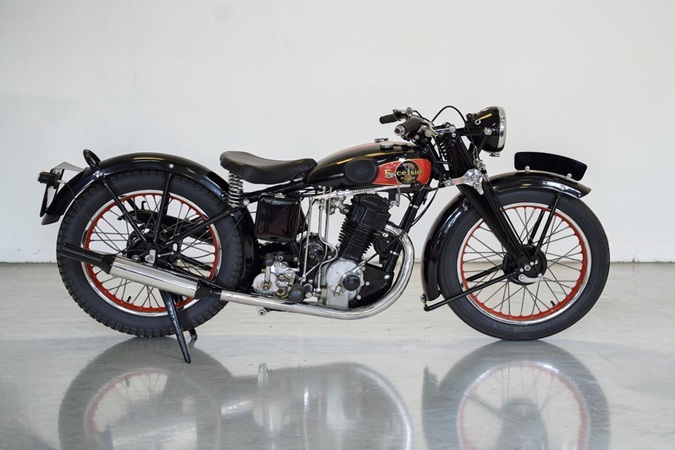
1922 Excelsior Model 4 1/4hp Blackburne - belongs to the post-World War I engineering phase in which Excelsior increasingly integrated externally supplied power units such as those from Blackburne, a British engine manufacturer known for its influence on racing and lightweight performance development. This 4-1/4 horsepower configuration reflects a period of technical consolidation, where Excelsior focused on reliability, side-valve efficiency, and adaptable engine sourcing rather than in-house experimental designs. Within the historical timeline of early 1920s motorcycle evolution, this model represents the shift toward standardized powerplants and the growing importance of supplier-driven engineering ecosystems in pre-modern motorcycle production.
Other notable models produced by the Excelsior Motor Manufacturing Company of Chicago further illustrate the breadth of its engineering and commercial development across the pre-war era. These include the early Excelsior Big Valve X series, developed for competitive racing and high-performance applications; the Excelsior Series 19, representing a more refined approach to touring-oriented V-twin motorcycles in the early 1920s; and the later Excelsior Super X models, which achieved widespread recognition for their balance of reliability, affordability, and mechanical efficiency. In addition, various board track racing machines and factory competition bikes contributed to Excelsior's presence in early American motorsport, reinforcing its reputation as both a manufacturer of durable road machines and a participant in the evolving culture of speed and endurance.
Excelsior motorcycles can be understood through their relationship to broader mechanical and industrial categories - from early V-twin development to racing platforms and sidecar-equipped transport systems.
Excelsior motorcycles played a central role in the expansion of motorized transport in the United States, particularly during a period of rapid industrial growth and infrastructure development.
Their V-twin configuration provided a practical balance of power and durability, making them suitable for both civilian use and competitive racing environments.
This evolution occurred alongside broader industry transformations, including wartime adaptations seen in WW2 military motorcycles, although Excelsior ceased operations prior to the war, further reinforcing the rarity of surviving machines.
Pre-1930 Excelsior motorcycles are widely regarded as historically significant due to their association with early industrial manufacturing and American racing culture.
Collector demand is typically focused on: original-condition V-twin engines, racing-derived models, and machines with documented historical usage.
As availability continues to decline, well-preserved Excelsior motorcycles are increasingly viewed as important artifacts within the global vintage motorcycle landscape.
When acquiring an Excelsior motorcycle, collectors should prioritize engine originality, frame integrity, and documented provenance - particularly given the historical importance of factory-produced components.
Exploring the global vintage motorcycle inventory provides additional context on availability, condition, and comparative rarity across different marques and eras.
Each motorcycle within our collection undergoes expert verification to ensure authenticity, mechanical accuracy, and long-term collector value.
Below is a curated selection of investment-grade Excelsior motorcycles available for acquisition. Each example is authenticated, documented, and sourced from reputable collections.
We offer Excelsior vintage motorcycles for sale to collectors worldwide, with professional crating, insured transport, and full export documentation.
Availability varies depending on rarity, provenance, and restoration quality. Please contact us directly for current listings and private acquisition opportunities.
Contact our specialists for availability, pricing, and worldwide shipping options. Request Availability!
Explore Excelsior Motorcycle models by engineering category, including V-twin performance platforms, board track racing machines, touring-oriented production systems, and early industrial-era motorcycle development.
The historical development of Excelsior Motorcycles is best understood within the framework of pre-war motorcycle engineering (1900s-1930s), a formative period in which American manufacturers transitioned from small-scale experimental machines toward industrialized production systems. Founded in Chicago, the Excelsior Motor Manufacturing Company distinguished itself through early adoption of scalable manufacturing processes and robust V-twin engine platforms, positioning the brand as a key participant in the industrial expansion of American motorcycling.
This engineering direction extended into the development of versatile road machines and sidecar-equipped configurations, where Excelsior motorcycles were frequently adapted for both civilian transport and commercial utility. These applications reflect a broader shift toward durability, load-bearing capability, and practical mobility during the 1910s and 1920s.
Unlike many later manufacturers, Excelsior's production concluded prior to the large-scale militarization of motorcycles during World War II motorcycle production, though its influence remained visible through the continuation of V-twin engineering principles and industrial manufacturing standards in subsequent decades.
In the broader transition toward post-war motorcycle development, Excelsior is typically regarded as a defining pre-war industrial manufacturer rather than a post-war innovator, making surviving machines essential reference points for early large-scale production and engineering consistency.
For collectors seeking comparative context across marques and eras, global vintage motorcycle inventory archives provide a structured framework in which Excelsior motorcycles can be evaluated alongside other historically significant machines from the same period.
What makes Excelsior motorcycles historically significant?
Excelsior Motorcycles is recognized for its role in early industrial-scale motorcycle manufacturing in the United States, particularly through durable V-twin platforms and its integration within the Schwinn organization. The brand also contributed to early American racing culture and mechanical standardization.
Are vintage Excelsior motorcycles rare?
Yes. Following the closure of Excelsior-Henderson in the early 1930s, surviving motorcycles - especially pre-1920s models and racing-oriented variants - are considered rare and historically important.
Which Excelsior models are most collectible?
Collector interest typically centers on early V-twin platforms, Big Valve performance models, and later Super X variants, particularly those with documented provenance and original mechanical components.
Are Excelsior motorcycles considered investment-grade assets?
Well-preserved Excelsior motorcycles with verified originality are widely regarded as significant early American industrial artifacts, with increasing interest among collectors focused on pre-war manufacturing history.
Excelsior motorcycles represent a foundational branch of early American motorcycling, defined by industrial manufacturing scale, durable V-twin engineering, and participation in early competitive racing environments. From early production models to refined platforms such as the Super X, Excelsior's development reflects a transition from mechanical experimentation to standardized manufacturing systems. Understanding production context, component originality, and historical usage is essential when evaluating these motorcycles as industrial and cultural artifacts.
The development of Excelsior Motorcycles is closely connected to the broader evolution of American industrial engineering in the early twentieth century, particularly within the context of Chicago-based manufacturing expansion. This perspective is best understood through comparative analysis of motorcycle manufacturers by country, alongside broader studies of American motorcycle heritage and early industrial development within American vintage motorcycle brands.
Within the global vintage motorcycle market, Excelsior motorcycles occupy a historically grounded segment defined by industrial provenance, early racing involvement, and limited surviving production. These characteristics align with broader trends outlined in vintage motorcycle market analysis, particularly within pre-war manufacturing categories where authenticity and documentation are critical.
Excelsior engineering is defined by its emphasis on durable V-twin architecture and scalable production systems during a period of rapid industrial expansion. These designs prioritized mechanical reliability, serviceability, and adaptability across both civilian and competitive environments.
Models such as early Big Valve configurations reflect the brand's engagement with high-performance engineering, while later platforms like the Super X illustrate the refinement of mass-produced motorcycles balancing performance with accessibility.
Gain access to thoroughly researched buyer guides and in-depth garage knowledge, including international delivery queries, model repair manuals, classic motorcycle issues, and full restoration procedures: