
The Vintage Motorcycles
Specialists in antique, classic, veteran and vintage motorcycles.
Specialists in antique, classic, veteran and vintage motorcycles.


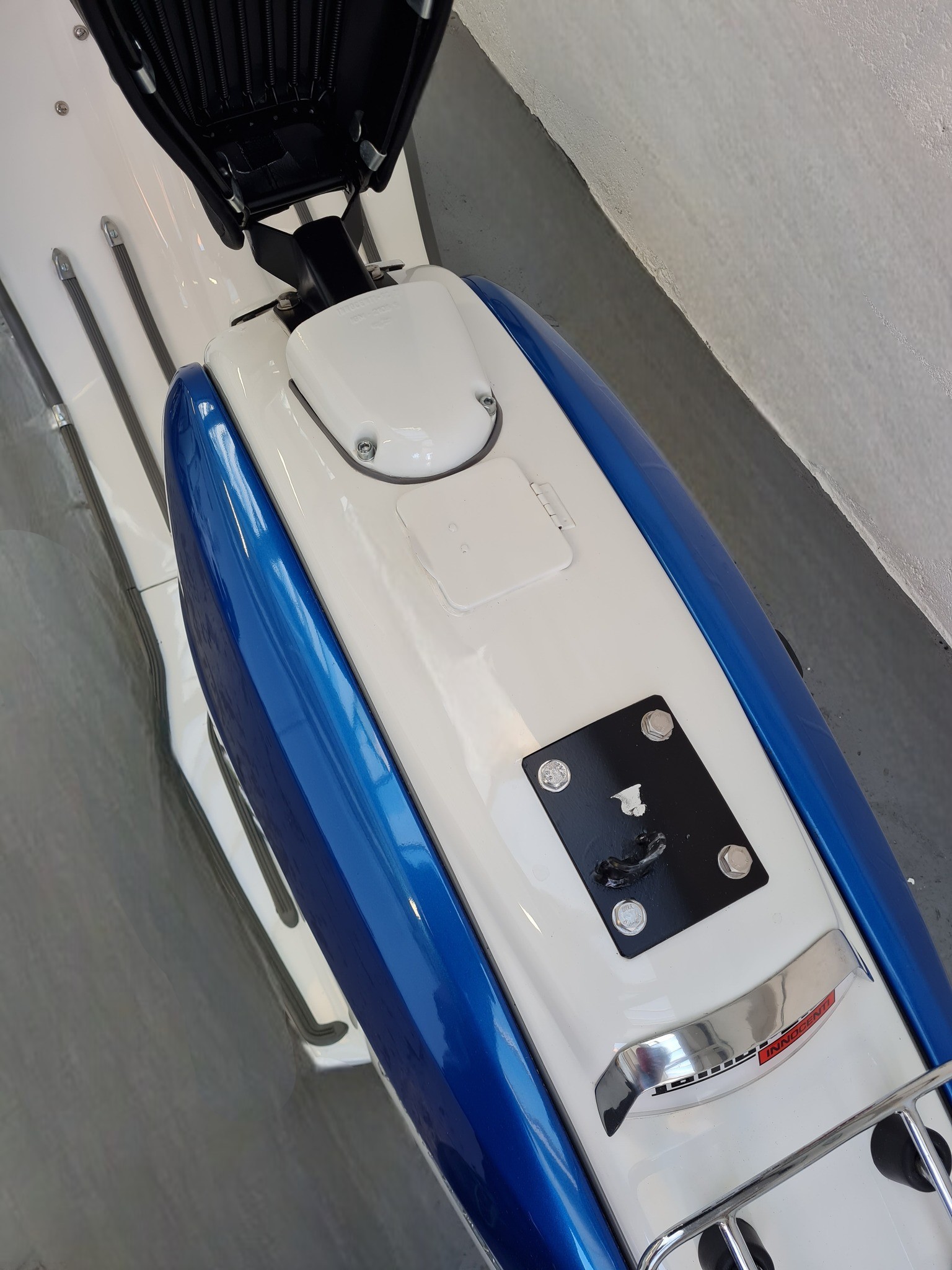


The 1965 Lambretta Li 150 Special was the sporting member of Innocenti's Series 3 scooter range, positioned above the standard Li 150 and below the larger TV 175. Introduced in 1963, the Li 150 Special combined the practical Series 3 chassis with a more powerful 148cc engine, closer-ratio gearing, and styling influenced by the TV family.
The Li 150 Special used an air-cooled two-stroke single-cylinder engine with a 57mm bore and 58mm stroke, giving an actual displacement of approximately 148cc. The engine produced about 8.25 horsepower at 5,590 rpm and gave the scooter a claimed maximum speed of approximately 85 km/h.
The Special was equipped with a Dell'Orto SH 1/18 carburetor and a four-speed hand-controlled gearbox. Its close-ratio transmission was one of the model's most important mechanical features and later made the Li 150 Special particularly popular as a foundation for performance tuning.
The 1965 model year is especially significant because Innocenti introduced the Silver Special and Golden Special designations during the year. From approximately May 1965, scooters received additional Silver or Golden identification according to their body color, while later 1965 production introduced further Series 3 running changes.
The Li 150 Special retained the distinctive Series 3 appearance, including the octagonal headset, revised front mudguard, slim body panels, and TV-inspired styling. Later 1965 examples also eliminated the chrome ring between the handlebar and leg shield.
With its lightweight chassis, 10-inch wheels, four-speed gearbox, and sporting 150-class engine, the 1965 Lambretta Li 150 Special remains one of the most recognizable and collectible Series 3 Lambrettas.
Innocenti introduced the Li 150 Special in September 1963 as a sportier alternative to the standard Li 150. It was designed to provide more performance and more distinctive styling without the additional cost and complexity of the TV 175.
The Special retained the 150-class engine size but received a revised cylinder and cylinder head, increased compression, and performance-oriented carburetion. Output increased to approximately 8.25 horsepower at 5,590 rpm.
A close-ratio four-speed gearbox was another defining feature. The revised gearing helped the rider make better use of the additional engine output and contributed to the model's reputation as a sporting Lambretta.
The Li 150 Special remained in production until October 1966. According to Innocenti production references, approximately 68,829 examples of the 150 Special were produced during the model's production run.
The 1965 frame-number range runs from 242976 to 259281, with the 150LIS frame prefix and 150LI engine prefix. Exact number conventions can vary slightly between reference sources, so frame and engine identification should always be checked against the appropriate production records.
During 1965, the model went through several important changes. The Silver and Golden Special designations appeared during the year, followed later by the elimination of the chrome ring between the handlebar and leg shield.
The 1965 Li 150 Special is therefore particularly interesting from a historical and collecting perspective because the year encompasses several distinct production configurations.
The 1965 Lambretta Li 150 Special is powered by an air-cooled two-stroke single-cylinder engine with an actual displacement of approximately 148cc.
The engine uses a 57mm bore and 58mm stroke. The slightly undersquare configuration provides a useful balance between low-speed flexibility and the ability to operate effectively at higher engine speeds.
Factory specifications give approximately 8.25 horsepower at 5,590 rpm. The claimed maximum speed is approximately 85 km/h, although actual road speed depends on rider position, weight, gearing, engine condition, and road conditions.
The carburetor is a Dell'Orto SH 1/18. Period maintenance specifications call for a 2 percent petrol-oil mixture and ignition timing of approximately 22 to 24 degrees before top dead center.
The engine uses forced-air cooling, with the cylinder and cylinder head enclosed by the characteristic Lambretta cooling system.
The revised engine specification gave the Li 150 Special noticeably more performance than the standard Li 150. The additional output was especially useful when accelerating through the gears or riding with a passenger.
The 150cc engine remained mechanically straightforward, making the Special relatively easy to maintain compared with more complex later motorcycles and scooters.
The Li 150 Special uses a four-speed constant-mesh manual gearbox controlled through the left-hand twist grip.
The gearbox was designed with closer ratios than the standard Li 150, allowing the rider to keep the engine closer to its useful power band during acceleration.
The close-ratio gearbox became one of the most appreciated features of the Special and later made the model popular with Lambretta enthusiasts interested in performance modifications.
The clutch is a multi-plate wet design operated through the left-hand handlebar lever.
Final drive is through an enclosed duplex chain. The chain runs inside the engine and transmission casing, protecting it from road contamination and maintaining the enclosed mechanical layout characteristic of Lambretta scooters.
The four-speed transmission gives the Li 150 Special useful flexibility in urban traffic while allowing the scooter to make effective use of its available power on open roads.
The 1965 Li 150 Special uses the Series 3 steel scooter frame with enclosed bodywork and a central floorboard tunnel.
The frame incorporates the fuel tank, leg shields, floorboard, engine mounting structure, side-panel mounts, and suspension components into the compact Lambretta chassis.
The Special uses the sportier body treatment derived from the TV family rather than the simpler appearance of the standard Li models.
The front suspension uses Lambretta's leading-link arrangement with oscillating connecting rods and spring and damping components. This design keeps the front suspension compact while providing controlled wheel movement.
The rear suspension is integrated with the rear engine and wheel assembly and uses a spring and damper arrangement.
The 10-inch wheels provide a useful combination of stability and maneuverability. The low center of gravity and relatively narrow body also make the scooter easy to handle in urban traffic.
Because the Special can achieve higher speeds than the standard Li 150, correct condition of the steering bearings, suspension components, wheel bearings, tires, and frame is particularly important on surviving examples.
The 1965 Lambretta Li 150 Special uses 10-inch wheels with 3.50 x 10 tires.
The wheels are pressed-steel split-rim assemblies, allowing straightforward removal for tire and inner-tube servicing.
Both front and rear wheels use aluminum-finned drum brakes. The front brake is operated by the handlebar lever while the rear brake is operated through the rider's foot pedal.
The finned aluminum brake drums help dissipate heat and are characteristic of the Series 3 Lambretta braking system.
The Li 150 Special did not use the front disc brake of the larger TV 200. The hydraulic disc-brake system remained associated with Innocenti's higher-performance models.
Original brake drums, hubs, shoes, cables, control mechanisms, and wheel rims are important when assessing the authenticity of a restored Special.
For road use today, the braking system should be inspected carefully because even a correctly restored vintage drum brake cannot be expected to perform exactly like a modern motorcycle braking system.
The Li 150 Special was deliberately styled as a sportier Series 3 Lambretta, borrowing several visual elements from the TV models.
The scooter features an octagonal headset, a revised front mudguard, slim horncasting, and distinctive side panels with front and rear finger flashes.
The side panels carry Special identification and are one of the most recognizable features of the model.
During 1965, Innocenti introduced the Silver Special and Golden Special designations. The Silver Special used the silver body treatment, while the Golden Special received the gold finish and corresponding Golden identification.
The Golden Special was distinguished by its extensive gold finish, including components that were not normally treated in the same way on the standard Li 150 Special. It also used a brown vinyl seat as part of the special specification.
The factory color schemes included Metallic Grey 8060 and Light Metallic Gold 8063. The gold finish was associated specifically with the Golden Special.
On later 1965 production, the chrome ring between the handlebar and leg shield was eliminated. This is an important visual detail when dating a surviving scooter.
The combination of slim Series 3 proportions, TV-inspired styling, metallic colors, and Special badging makes the 1965 model particularly distinctive.
The 1965 Li 150 Special is best understood as a year of transition because several production changes occurred during the year.
The early 1965 scooters continued the second-version specification that had been introduced during 1964. The side-panel anti-vibration buffers used the metal-spring arrangement introduced during the previous production phase.
From approximately May 1965, Innocenti introduced the Silver and Golden Special identification. The appropriate Silver or Golden designation was added according to the scooter's body color.
The Silver Special was finished in metallic silver, while the Golden Special used a gold metallic finish. The Golden version also received a brown vinyl seat.
From approximately September 1965, the third major production configuration eliminated the chrome ring between the handlebar and leg shield.
The later production configuration also introduced simplified side-panel catches, with the cogged arrangement being replaced by the later type from January 1966.
These changes are valuable authentication clues because a 1965 scooter can legitimately display different combinations of Series 3 components depending on its exact production date.
The Li 150 Special offers a lively and responsive riding experience compared with the standard Li 150.
The 148cc two-stroke engine produces approximately 8.25 horsepower, while the close-ratio gearbox allows the rider to keep the engine operating effectively through all four gears.
The scooter's low center of gravity makes it easy to maneuver, while the 10-inch wheels provide useful stability at higher road speeds.
The engine responds best when allowed to rev rather than being operated at very low rpm in a high gear.
The close-ratio transmission is particularly useful when accelerating uphill or carrying a passenger because the engine does not fall as far outside its useful power range between gear changes.
The Special remains a practical urban scooter, but its additional performance makes it considerably more versatile for longer journeys than the smaller 125cc Lambretta models.
The Li 150 Special played an important role in Innocenti's strategy for the Series 3 range by providing a performance-oriented scooter below the TV 175.
The model offered customers more power and distinctive styling without the higher price associated with the flagship TV models.
The Special also became an important performance platform because its 150cc engine and close-ratio gearbox provided a strong basis for tuning.
Innocenti continued development of the model through the mid-1960s, introducing the Silver and Golden Special variants in 1965 and continuing production into October 1966.
Approximately 68,829 Li 150 Specials were produced during the full production run, making the model considerably more common than the TV 200 but still highly desirable in original condition.
The model's combination of sporting mechanical specification and attractive styling helped establish the Special name as an important part of Lambretta's later Series 3 history.
The 1965 Lambretta Li 150 Special is particularly attractive to collectors because it combines the mature Series 3 design with the model's most recognizable Special-era color schemes.
The Silver and Golden Special versions are especially sought after when their original colors, trim, badges, and mechanical components have survived together.
The 1965 frame-number range is approximately 242976 to 259281, with the 150LIS frame prefix and 150LI engine prefix.
The engine should correspond to the 148cc specification with a 57mm bore and 58mm stroke, Dell'Orto SH 1/18 carburetor, and 8.25 horsepower output.
The close-ratio four-speed gearbox is another important feature and should be checked when evaluating a supposedly original Special.
Bodywork is equally important. Original Special side panels, headset, front mudguard, leg shield, badges, and period-correct paint can distinguish a genuine collector-quality example from a scooter assembled from later or reproduction parts.
On a Silver or Golden Special, the correct metallic finish and corresponding identification badges are particularly important. A Golden Special should also retain its period-correct brown vinyl seat if originality is being claimed.
Documentation showing the original registration, frame number, engine number, market, color, and ownership history can significantly strengthen provenance.
Authenticating a 1965 Lambretta Li 150 Special requires examination of the frame and engine identification, engine specification, gearbox, bodywork, color, trim, and production-specific details.
The correct frame prefix is 150LIS and the engine prefix is 150LI. The 1965 frame-number sequence runs approximately from 242976 to 259281.
The engine should correspond to the 148cc two-stroke specification with a 57mm bore and 58mm stroke. The Dell'Orto SH 1/18 carburetor and correct engine components provide additional evidence.
The Special gearbox should also be considered because the close-ratio transmission is a defining mechanical feature of the model.
For an early 1965 example, the chrome ring between the handlebar and leg shield can still be correct. On later 1965 production, this ring was eliminated.
The Silver and Golden badges are also date-sensitive. They were introduced during 1965 rather than being present throughout the entire Li 150 Special production period.
The Golden Special should have the appropriate gold body treatment and associated trim. Its brown vinyl seat is another useful identification detail.
Reproduction panels, badges, seats, paint, and trim are common, so authentication should rely on the consistency of the entire scooter rather than any single component.
A convincing original or correctly restored example should show a logical relationship between its frame number, engine, production version, bodywork, color scheme, controls, wheels, suspension, and historical documentation.
The 1965 Lambretta Li 150 Special matters because it represents the mature sporting version of Innocenti's Series 3 Li platform.
Its 148cc two-stroke engine produced approximately 8.25 horsepower, while the close-ratio four-speed gearbox gave the scooter a more responsive and sporting character than the standard Li 150.
The 1965 model is especially important because it introduced the Silver and Golden Special variants, which have become among the most recognizable collector versions of the Series 3 Lambretta.
The year also captures an important stage in Innocenti's running development of the Series 3 chassis. Later 1965 scooters eliminated the chrome ring between the headset and leg shield, while further changes to the side-panel catches followed in 1966.
The Special's combination of accessible performance, distinctive styling, and tuning potential also made it an influential model within the Lambretta enthusiast and competition scene.
For collectors, the 1965 Li 150 Special is therefore significant not simply as a vintage scooter but as one of the key models that defined the later development of the Series 3 Lambretta range.
This 1965 Lambretta Li 150 Special represents one of Innocenti's most desirable Series 3 sporting scooters and an important stage in the development of the Special range.
The 148cc air-cooled two-stroke single-cylinder engine uses a 57mm bore and 58mm stroke and produces approximately 8.25 horsepower at 5,590 rpm, with a claimed maximum speed of approximately 85 km/h.
The four-speed close-ratio gearbox, Dell'Orto SH 1/18 carburetor, enclosed duplex chain final drive, 10-inch wheels, and aluminum-finned drum brakes provide the distinctive mechanical specification of the Li 150 Special.
The 1965 model is particularly significant because Innocenti introduced the Silver Special and Golden Special variants during the year. The Silver version used metallic silver bodywork, while the Golden Special received its distinctive gold finish and brown vinyl seat.
Later 1965 production also eliminated the chrome ring between the handlebar and leg shield, making the precise production date important when evaluating the originality of a surviving scooter.
The 150LIS frame prefix, 150LI engine prefix, 1965 frame-number range of approximately 242976 to 259281, correct engine, close-ratio gearbox, Special bodywork, badges, paint, and trim should all be considered when establishing authenticity.
Contact us for additional photographs, detailed specifications, frame and engine numbers, service history, originality assessment, provenance, restoration details, historical documentation, and purchasing information for this 1965 Lambretta Li 150 Special.
Explore more Lambretta motorcycles and scooters from the vintage and classic eras.
The Vintage Motorcycles presents a curated selection of historically significant Italian machines, where Lambretta represents a distinct chapter in the evolution of post-war European mobility. Emerging in the aftermath of World War II, Lambretta redefined urban transportation through compact engineering, monocoque construction, and highly efficient small-displacement engines designed for everyday usability.
Within the broader ecosystem of global vintage motorcycle manufacturers, Lambretta occupies a unique position, bridging the gap between traditional motorcycle design and the rise of modern scooter-based mobility. Its development is best understood in contrast to earlier pre-war motorcycle engineering (1900-1939), where larger displacement machines dominated, before giving way to the practical and accessible solutions that defined the post-war period.
This transition becomes particularly evident when examined alongside post-war motorcycle development, where manufacturers across Italy adapted to new economic realities by producing lightweight, efficient vehicles. Lambretta, alongside a handful of other Italian innovators, played a central role in this transformation, creating machines that prioritized accessibility without abandoning engineering integrity.
Each Lambretta within our collection is selected based on provenance, originality, and mechanical correctness, ensuring alignment with museum-grade preservation standards. Available acquisition opportunities can be explored through our global vintage motorcycle inventory, with all motorcycles supported by a fully insured international shipping service.
Lambretta's development is closely tied to Italy's post-war industrial recovery, where engineering priorities shifted toward efficiency, affordability, and mass accessibility. Unlike traditional motorcycles designed for long-distance touring or competition, Lambretta scooters were engineered as practical transport solutions for dense urban environments, featuring enclosed drivetrains, step-through frames, and compact engine layouts.
This shift reflects a broader transformation in European mobility following the Second World War, a period further explored through WW2 military motorcycle development, where industrial capacity and mechanical innovation were redirected toward civilian applications. In this context, Lambretta stands as a defining example of how wartime engineering knowledge was adapted into everyday transportation systems.
Additionally, Lambretta's influence extended beyond solo riding configurations, with certain adaptations and regional uses intersecting with broader utility concepts such as sidecar-equipped motorcycles, highlighting the versatility of European vehicle design during the mid-20th century.
Italian engineering, as represented by Lambretta, is characterized by a synthesis of functionality and design clarity. Rather than focusing solely on performance metrics, Lambretta emphasized usability, structural efficiency, and visual simplicity, resulting in machines that became cultural icons as much as mechanical products.
From early Model A and B scooters to later Li and TV series, Lambretta developed a diverse range of machines that reflected both technological refinement and evolving urban lifestyles. These models collectively illustrate a different trajectory in motorcycle history, one centered on accessibility and industrial design rather than speed or displacement.
Today, Lambretta remains a critical reference point in the study of post-war mobility, representing a shift in engineering priorities that continues to influence modern two-wheel transportation. For collectors, these machines offer not only historical significance but also insight into a transformative era where motorcycles became an integral part of everyday life.
Key Highlights
Collector Assurance
All enquiries handled with discretion. We typically respond within 6 hours.
Choose the payment method that is most convenient for you. We accept widely used international payment methods as well as, where available, local bank transfer options that allow you to pay like a domestic transaction. Full payment instructions are provided for your specific purchase.
Direct international bank wire transfer is available for motorcycle purchases and export transactions.
Credit card payments can be arranged through Wise.com, subject to the applicable payment and processing conditions.
PayPal is accepted. A 5% PayPal processing fee applies to the transaction.