The Vintage Motorcycles
Specialists in antique, classic, veteran and vintage motorcycles.
Specialists in antique, classic, veteran and vintage motorcycles.
A museum-grade portfolio of Douglas motorcycles, showcasing one of Britain's most technically distinctive engineering marques. From early 1920s flat-twin pioneers to interwar sporting machines and refined post-war designs, each example represents a rare chapter in the evolution of horizontally opposed motorcycle engineering.
Curated by European and British vintage motorcycle specialists. Each Douglas motorcycle is selected for historical importance, mechanical originality, and preservation quality suitable for museum collections and international auctions.
Douglas Motorcycles holds a unique position in British engineering history, defined by its pioneering use of the horizontally opposed flat-twin engine configuration long before it became widely adopted.
Unlike conventional British single-cylinder designs of the era, Douglas machines delivered exceptional balance, low center of gravity, and mechanical smoothness - characteristics that made them both competitive in racing and highly capable as long-distance touring motorcycles.
These motorcycles are not merely transport machines, but early expressions of alternative engineering philosophy, influencing decades of motorcycle design worldwide.
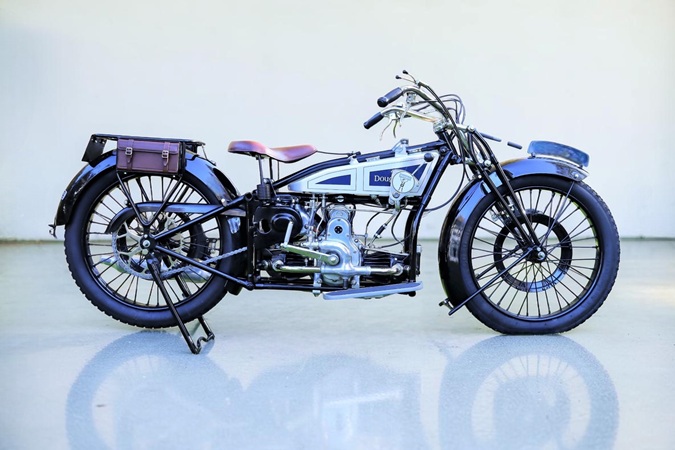
Early Douglas motorcycles, including the Model B20 4hp (1920), were developed during a period of rapid industrial transition following World War I. These machines represent some of the earliest practical applications of flat-twin architecture in mass-produced motorcycles.
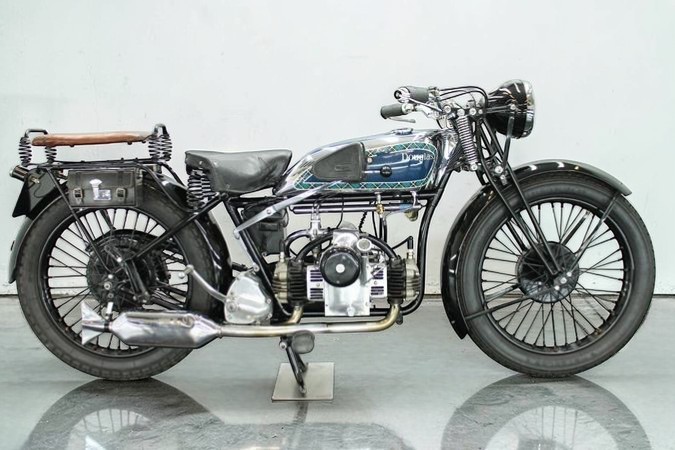
By the 1930s, Douglas had refined its engineering into more robust and performance-oriented machines such as the C32 Bulldog, a model known for its durability, distinctive styling, and strong road presence.
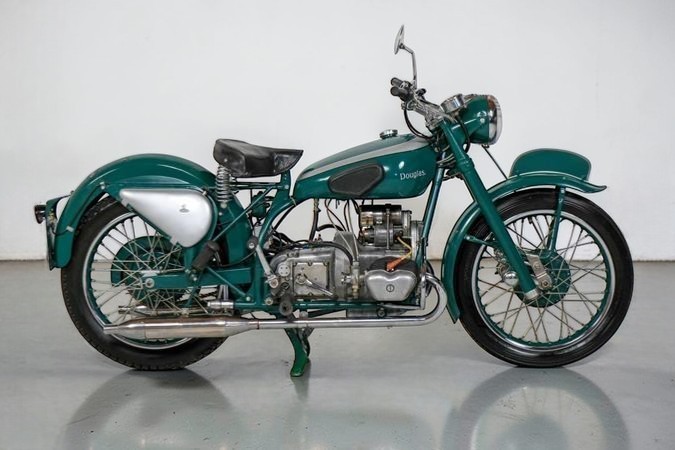
Post-war models like the Mark V 350 (1952) demonstrate the final evolution of Douglas engineering, combining classic flat-twin design with improved reliability and usability for modern road conditions.
Today, surviving Douglas motorcycles are exceptionally rare, particularly those retaining original components and documented restoration history.
1882 - Douglas Engineering was established in Bristol, England, originally specializing in precision engineering and industrial machinery.
1907 - Douglas introduced its first motorcycles, adopting horizontally opposed flat-twin engine layouts that would define the brand's identity.
1910s - The company gained recognition for lightweight engineering, smooth power delivery, and competitive success in endurance racing events.
1914-1918 - During World War I, Douglas supplied military motorcycles to British forces, expanding production and technical development.
1920s - Douglas became internationally known for advanced flat-twin motorcycles with low center-of-gravity handling and refined road performance.
1923 - The brand achieved major racing success at the Isle of Man TT, strengthening its reputation in British motorsport engineering.
1930s - Engineering evolved with improved overhead-valve engines, stronger frames, and more sophisticated touring motorcycles.
1935 - Douglas introduced models with modernized styling and enhanced chassis refinement aimed at long-distance reliability.
1940s - Wartime production demands shifted focus toward military and industrial manufacturing during World War II.
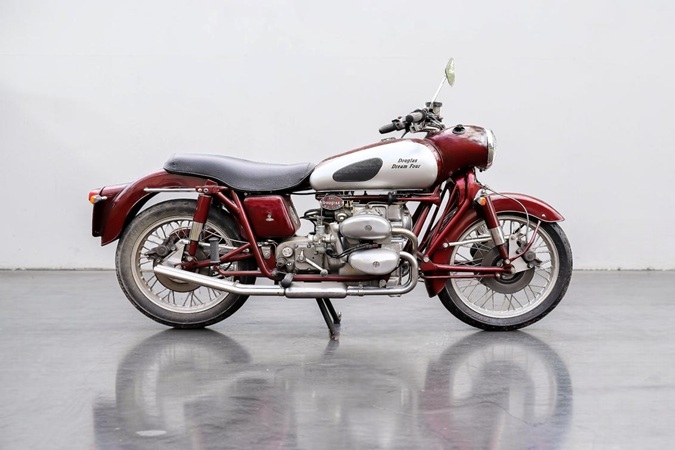
1950s - The company attempted to modernize its motorcycle lineup but struggled against growing competition from larger British and international manufacturers.
1957 - Motorcycle production effectively came to an end, closing an important chapter in early British flat-twin engineering history.
Modern Era - Douglas motorcycles remain respected among vintage collectors for their distinctive flat-twin layouts, lightweight handling, and pioneering engineering design.
Douglas motorcycles occupy a highly specialized niche within the global collector market. Their unconventional engineering and relatively low production numbers make them particularly attractive to advanced collectors seeking rarity and technical distinction.
Many surviving examples remain in long-term private collections or institutional holdings, making publicly available, collector-grade machines increasingly difficult to source.
As a result, authenticated Douglas motorcycles with matching numbers and provenance often achieve strong demand in private sales and specialist auctions.
Key collector examples include the Douglas Model B20 4hp (1920), Douglas Model C32 Bulldog (1932), and the Douglas Model Mark V 350 (1952). These scooters are highly regarded for their design innovation, cultural significance, and collector appeal. And you can explore our full range of vintage motorcycles in the Inventory page.
These machines represent critical milestones in flat-twin motorcycle development, bridging early experimentation with later refinement in engineering design.
Additional Douglas models - including earlier pre-war variants and rare competition machines - continue to play an important role in the marque's long-term collector relevance.
Douglas is one of the earliest pioneers of flat-twin motorcycle engineering, a configuration that would later become globally influential.
Its contribution to both civilian transport and early motorsport, including participation in events such as the Isle of Man TT, cements its legacy as a technically innovative and historically important manufacturer.
Douglas motorcycles are increasingly viewed as engineering artifacts rather than conventional collectibles. Their value lies not only in scarcity, but in their role as early innovators of mechanical design that diverged from mainstream British motorcycle architecture.
For collectors focused on technical history and mechanical uniqueness, Douglas represents one of the most compelling acquisition categories within the vintage motorcycle market.
When acquiring a Douglas motorcycle, collectors should pay particular attention to engine originality, matching numbers, and correct flat-twin mechanical configuration.
Due to their unique engineering, restoration quality and authenticity are especially critical, as incorrect modifications can significantly impact both value and historical accuracy.
Each Douglas motorcycle in our collection undergoes careful inspection and documentation to ensure collector-grade standards and historical integrity.
Below is a curated selection of collector-grade Douglas motorcycles available for acquisition. Each machine is verified, documented, and offered with full provenance.
We offer Douglas vintage motorcycles for sale to collectors worldwide, including the United Kingdom, Europe, United States, Australia, and Asia. Each motorcycle can be professionally crated and shipped with full export documentation and insurance.
Pricing varies depending on rarity, originality, and restoration quality. Please contact us directly for current availability and acquisition opportunities.
Contact our specialists for availability, pricing, and worldwide shipping options. Request Availability!
The development of Douglas motorcycles is best understood within the broader framework of pre-war motorcycle engineering (1900-1939), a period defined by rapid experimentation in engine configuration and mechanical balance. Unlike many British manufacturers of the era, Douglas established a distinct engineering identity through its longitudinal flat-twin engine layout, which provided improved weight distribution and mechanical stability.
This early innovation later influenced the direction of post-war motorcycle development, where efficiency, mass production, and simplified mechanical systems became central to European motorcycle manufacturing.
During periods of global conflict, these engineering principles were further tested in the context of World War II military motorcycle deployment, where reliability, ease of maintenance, and structural balance were critical operational requirements - qualities inherently aligned with Douglas design philosophy.
For collectors seeking broader comparative insight, global vintage motorcycle inventory archives provide a wider context in which Douglas machines can be evaluated alongside other British and European engineering traditions.
What makes Douglas motorcycles unique?
Douglas motorcycles are defined by their early adoption of the flat-twin engine configuration, offering improved balance and a distinctive approach to mechanical layout compared to conventional single-cylinder designs.
Are Douglas motorcycles rare?
Yes. Due to limited production and the passage of time, surviving Douglas motorcycles - particularly in original condition - are increasingly scarce within the collector market.
Are Douglas motorcycles collectible?
They are highly collectible, especially among enthusiasts focused on early engineering innovation and non-standard mechanical configurations within British motorcycle history.
Are Douglas motorcycles a good investment?
Well-documented Douglas motorcycles with preserved originality are considered strong long-term collector assets, particularly as interest in early engineering diversity continues to grow.
Douglas motorcycles represent one of the most distinctive engineering paths in British motorcycling history, where innovation was driven by mechanical balance rather than conventional performance metrics. From early pre-war machines to later developments, Douglas models illustrate an alternative approach to motorcycle design that diverges from mainstream British engineering traditions. Understanding the provenance, structural integrity, and mechanical uniqueness of these machines is essential for collectors evaluating long-term historical significance.
In certain configurations, Douglas motorcycles also intersect with the development of sidecar-equipped motorcycle systems, where the inherent balance of flat-twin engines provided advantages in stability and load distribution.
The evolution of Douglas motorcycles can be contextualized within the wider landscape of British engineering, from early 20th-century experimentation to more refined interwar and post-war production models. This broader perspective is explored through comparative studies of motorcycle manufacturers by country, alongside focused insights into British motorcycle brand development and the historical trajectory outlined in the evolution of British motorcycles.
Within the global vintage motorcycle market, Douglas occupies a niche defined by engineering uniqueness and historical differentiation. These dynamics align with broader observations in vintage motorcycle market analysis, where machines with distinctive mechanical architecture are increasingly valued by specialized collectors.
Douglas engineering reflects a broader narrative within early motorcycle development, where alternative mechanical configurations contributed to the diversity of design solutions across Europe. Its flat-twin architecture, lightweight construction, and emphasis on balance position Douglas as a key reference point in studies of early motorcycle engineering evolution.
Delve into crucial buyer information and hands-on mechanical guides, covering cross-border sales FAQs, specific engine troubleshooting, traditional bike maintenance, and our restoration garage techniques: