
The Vintage Motorcycles
Specialists in antique, classic, veteran and vintage motorcycles.
Specialists in antique, classic, veteran and vintage motorcycles.










The 1939 BSA Model M24 Gold Star was one of the most important British sporting motorcycles produced immediately before the Second World War. Built by the Birmingham Small Arms Company, the M24 combined a 496cc overhead-valve single-cylinder engine with a lightweight Reynolds 531 frame, rigid rear suspension, girder front forks, and competition-oriented equipment.
The M24 was the original production Gold Star and was developed following Wal Handley's remarkable Brooklands performance in 1937. Handley achieved a lap above 100 mph on a BSA Empire Star, earning the Brooklands Gold Star award that inspired BSA to apply the name to its new high-performance single.
The 1939 machine was designated KM24 and represented the second production version of the M24 after the 1938 JM24. BSA introduced a number of technical and cosmetic changes for 1939, including a revised crankcase and timing gear arrangement, an aluminium gearbox housing, close-ratio gearbox as standard, a revised fuel tank, and updated electrical equipment.
At the heart of the motorcycle is an all-alloy 496cc overhead-valve single-cylinder engine with an 82 mm bore and 94 mm stroke. The standard compression ratio was 7.75:1, with a high-compression piston available for competition applications.
The 1939 engine produced approximately 29 to 30 bhp at 5,800 rpm in standard specification. Its combination of relatively large displacement, high compression, lightweight construction, and sporting valve timing gave the M24 a strong performance for a pre-war production single.
The motorcycle's chassis was equally important. Reynolds 531 high-tensile tubing was used for the frame and girder forks, while the absence of sidecar mounting lugs emphasized that the Gold Star was intended as a sporting machine rather than a utility motorcycle.
The 1939 M24 remains historically significant as the final pre-war Gold Star specification and as the direct ancestor of the famous post-war Gold Star models that became icons of British performance motorcycling.
The origins of the Gold Star name can be traced to Brooklands in 1937, when Wal Handley returned to competition riding a BSA Empire Star. During a three-lap race, Handley achieved a fastest lap of 107.57 mph and an overall average of 102.27 mph, exceeding the 100 mph threshold associated with the Brooklands Gold Star award.
BSA recognized the marketing and engineering potential of this achievement and began developing an all-alloy 500cc sporting motorcycle carrying the Gold Star name.
Production of the new M24 began during 1937, with the first machines appearing before the official 1938 model year. The first production examples were designated JM24.
The 1939 version was designated KM24. Engine and frame numbers began at KM24 101, and numerous changes distinguished the KM24 from the earlier JM24.
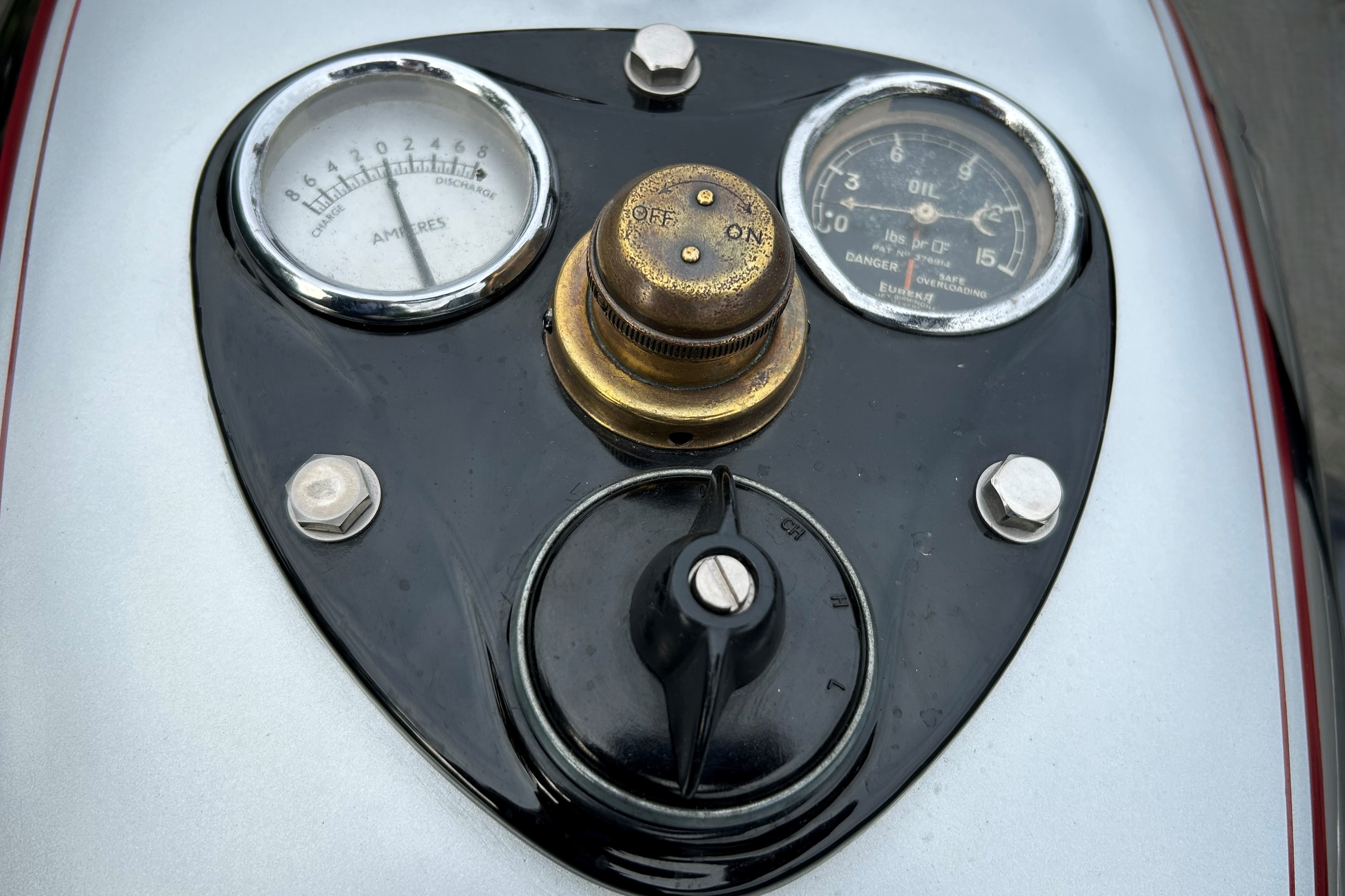
The KM24 received a new petrol tank with a tank-top instrument panel, a redesigned oil tank, a frame-mounted toolbox, and a short side stand mounted to the lower left frame rail.
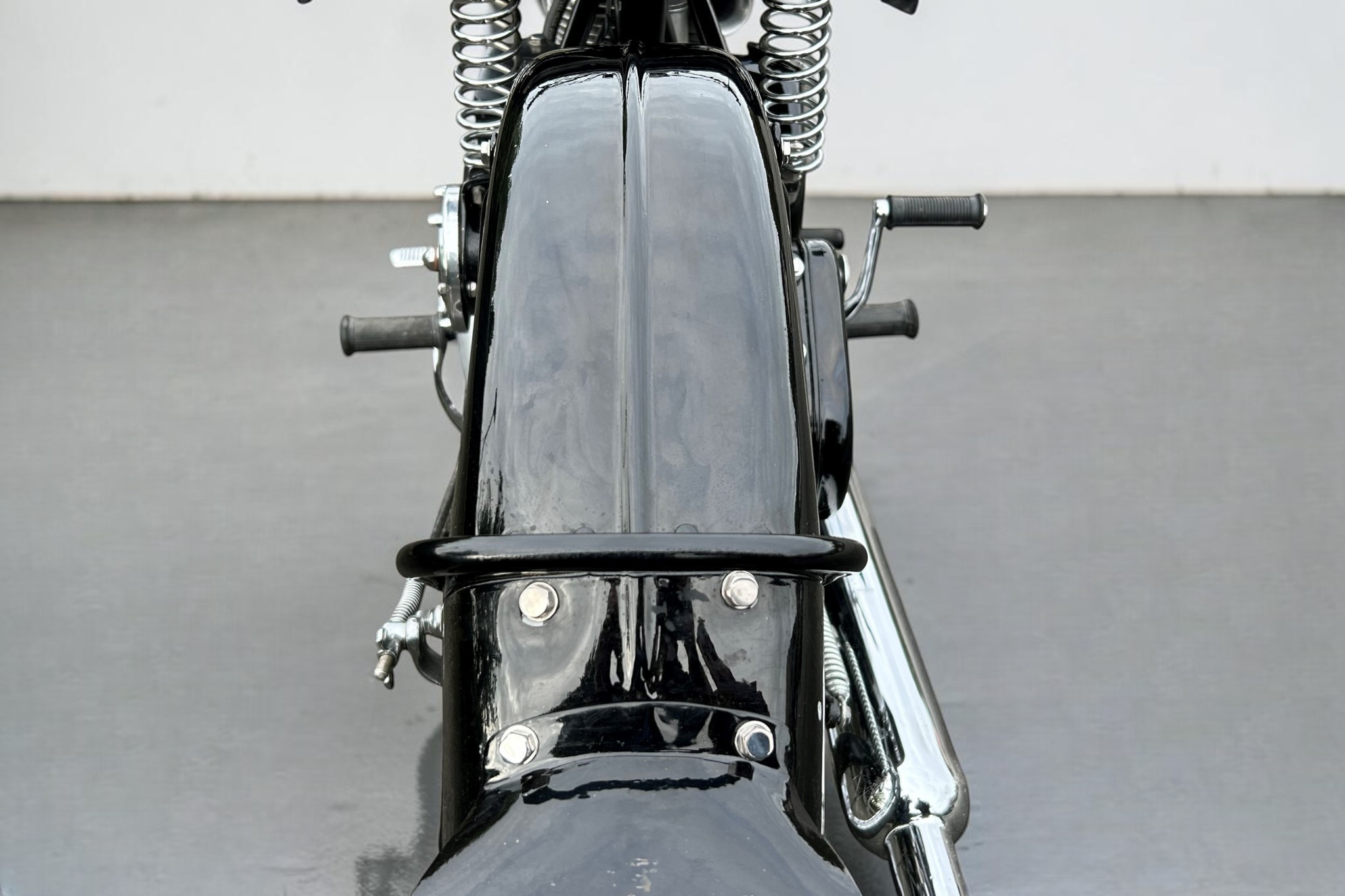
The 1939 model also received a revised rear mudguard, changes to the exhaust system, an aluminium-alloy gearbox housing replacing the Elektron magnesium housing used on the 1938 machine, and a close-ratio gearbox offered as standard.
Production continued until the outbreak of the Second World War in September 1939. The last recorded KM24, frame number KM24 422, was dispatched to the War Office on September 6, 1939.
A total of 298 KM24 Gold Stars were produced, of which 120 were dispatched to destinations outside the United Kingdom. Combined with approximately 266 JM24 machines, this resulted in only about 564 pre-war M24 Gold Stars.
Eight 1939 KM24 Gold Stars were supplied directly to the War Office from BSA's completed stock. These machines were essentially civilian motorcycles adapted primarily through military paintwork rather than being purpose-built military versions of the M24.
The 1939 BSA M24 Gold Star uses a 496cc air-cooled four-stroke single-cylinder overhead-valve engine.
The bore measures 82 mm and the stroke 94 mm. This long-stroke configuration provides a substantial torque output while retaining the relatively compact dimensions of a single-cylinder engine.
The engine uses an aluminium cylinder barrel with a pressed-in steel liner and an aluminium cylinder head incorporating cast-in bronze thread inserts and screwed-in steel valve seats.
The standard compression ratio is 7.75:1. A high-compression piston capable of producing a 12.5:1 compression ratio was available for specialized competition use with suitable fuel.
Standard output is approximately 29 to 30 bhp at 5,800 rpm. Although modest by modern standards, this was a strong output for a 496cc production single in 1939, particularly when combined with the M24's relatively low weight.
The 1939 carburetor specification was an Amal 10TT38 with a 1 5/32-inch bore. The standard main jet was 350, with a number 6 throttle valve and the needle positioned in the fourth groove.
The Gold Star's all-alloy engine construction reduced weight and represented an important engineering step for BSA. The combination of lightweight materials and competition-derived tuning helped establish the performance identity that would later become synonymous with the Gold Star name.
The engine was designed to operate at substantially higher performance levels than BSA's ordinary utility singles. Its combination of high compression, overhead valves, lightweight construction, and tuned induction made it suitable for both fast road riding and competition development.
The 1939 KM24 uses a four-speed foot-change gearbox housed in an aluminium-alloy casing. The earlier 1938 Gold Star used Elektron magnesium-alloy gearbox cases, but this material was discontinued for the 1939 model.
Close-ratio gearing was offered as standard for 1939, reflecting the motorcycle's sporting purpose. Standard wider ratios remained available as an option.
The standard 1939 close-ratio gearbox has approximately 11.85:1 first gear, 8.3:1 second gear, 5.25:1 third gear, and 4.8:1 fourth gear.
The close ratios allowed the rider to keep the engine within its useful power range during fast riding and competition use.
The clutch is a six-spring wet multi-plate unit using a 43-tooth chain wheel. Primary drive is through a single-row chain from the 21-tooth four-lobe cush-drive engine sprocket.
The gearbox uses an 18-tooth sprocket, driving the 42-tooth rear wheel sprocket through a 5/8 x 1/4-inch final drive chain.
The drivetrain was designed to transfer the M24's relatively high specific output efficiently while maintaining the durability required for sporting use.
The KM24 uses a lightweight Reynolds 531 high-tensile steel frame. The frame has a single front down tube and a rigid rear section.
Unlike many conventional BSA road motorcycles of the period, the Gold Star frame was built without sidecar mounting lugs. This was a deliberate indication of the M24's sporting purpose.
The 1939 KM24 incorporated a small side-stand lug on the rear portion of the frame, allowing the motorcycle to be supported without relying exclusively on a center stand.
At the front is a BSA single-spring girder fork constructed using Reynolds 531 tubing. The girder design was typical of high-performance British motorcycles immediately before the widespread adoption of telescopic forks.
The rear of the motorcycle is rigid, with no rear suspension system. Rider comfort was provided by the sprung saddle and the relatively substantial tires.
The lightweight frame was a major contributor to the Gold Star's performance. Rather than simply increasing engine power, BSA reduced chassis weight and used high-tensile tubing to create a motorcycle with a favorable power-to-weight ratio.
The standard 1939 KM24 uses a 20-inch WM1 front wheel and a 19-inch WM3 rear wheel. Competition models could use a 21-inch front wheel for improved performance over rougher surfaces.
Jones rims were used on the standard BSA wheels of the period.
The standard front tire size was 3.00 x 20 inches, while the 1939 rear tire was increased to 3.50 x 19 inches.
The motorcycle uses 7-inch single-leading-shoe drum brakes at both front and rear.
The combination of lightweight construction, large-diameter front wheel, rigid rear frame, girder fork, and drum brakes provided a purposeful sporting chassis for late-1930s road and competition use.
The Gold Star's chassis was not intended to provide modern levels of suspension travel or braking performance. Instead, its engineering priorities were low weight, mechanical simplicity, stability, and predictable handling.
The 1939 BSA M24 Gold Star has a distinctive appearance created by its narrow sporting fuel tank, exposed alloy engine, lightweight frame, girder fork, and compact rear section.
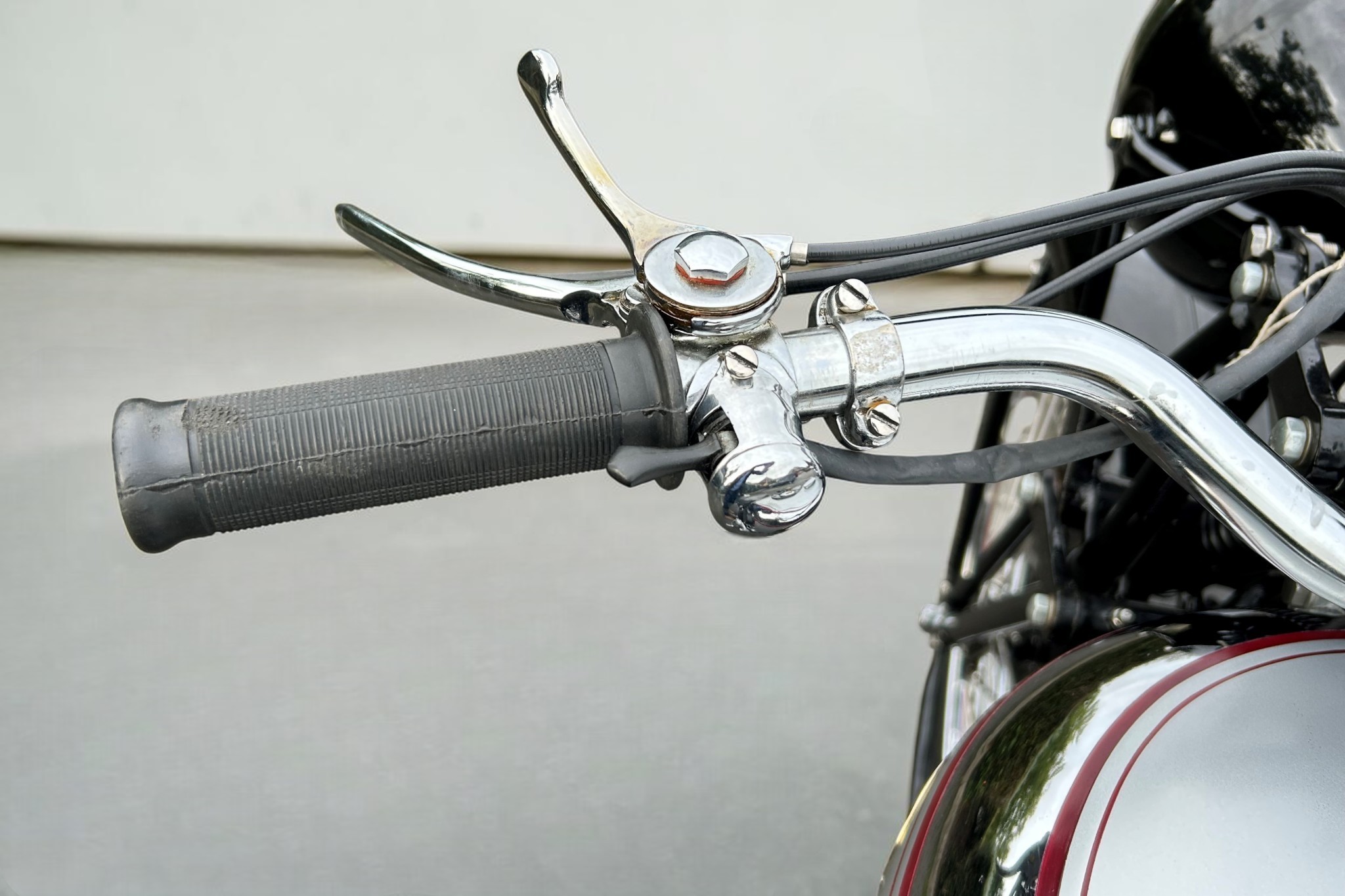
The 1939 KM24 was finished in black and chrome. The petrol tank featured a matt silver center panel lined with maroon pinstripes, while the wheel rims incorporated a matt silver center stripe also lined in maroon.
The oil tank, toolbox, and rear mudguard were lined in gold, adding a subtle visual connection to the Gold Star name.
The new 1939 petrol tank incorporated a tank-top instrument panel containing the Lucas ammeter and lighting switch on standard machines. The tank also incorporated other equipment that had been positioned differently on earlier models.
The 8-inch Lucas headlamp reverted to a plain shell for 1939. The rear mudguard became valanced, with a valanced front mudguard available as an option.
The exhaust pipe profile became more angular on the KM24, and the silencer no longer used the separate tailpipe found on the earlier model.
These details distinguish the 1939 KM24 from the 1938 JM24 and are important when assessing the originality of a surviving motorcycle.
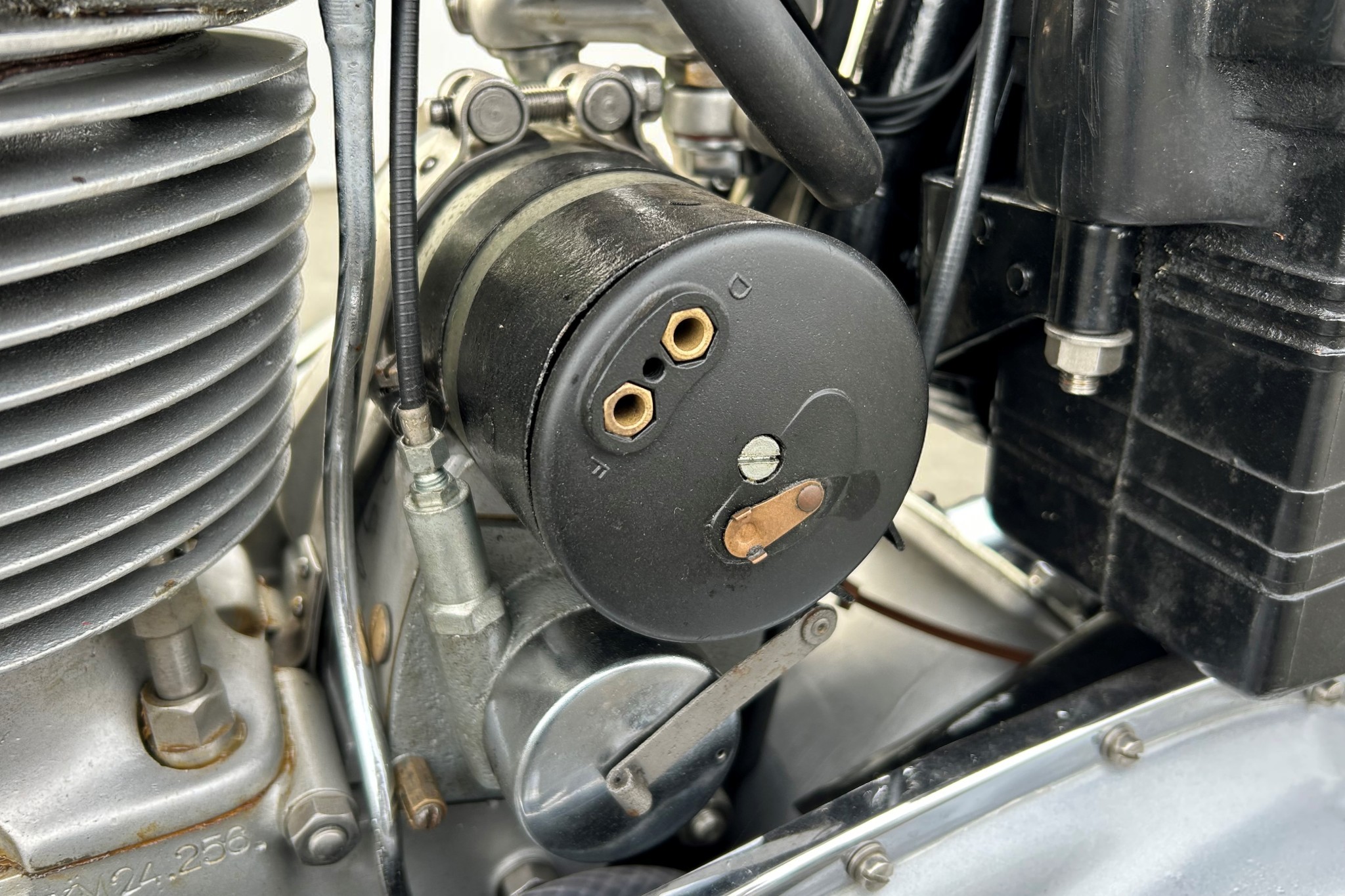
The 1939 M24 used Lucas electrical equipment including an MO1 magdyno, E3HM dynamo, MCR1 voltage control unit, DU142 headlight, and MT110 rear light.
The standard horn was a Lucas HF1441 on the 1939 KM24.
The speedometer was supplied by Jaeger Smiths Industries. The original instrument was a 120 mph Smiths unit, and surviving examples can be identified by the period pin-drive arrangement.
On original machines, the speedometer drive was taken from the front wheel. The instrument case did not originally have provision for an electric light, although an illuminated speedometer was available as an optional extra.
The electrical wiring also changed for 1939. Lucas introduced color-coded wiring, whereas earlier models generally used black wiring with colored tracer rings at the ends.
The location of the lighting switch and ammeter also differed according to KM24 specification. Standard 1939 machines placed the instruments in the petrol tank panel, while some competition versions retained the controls in the headlamp.
The M24 Gold Star was developed from the beginning with competition in mind. Its lightweight Reynolds 531 frame, alloy engine, high-compression potential, close-ratio gearbox, and sporting cycle components provided a strong basis for competition preparation.
Early Gold Stars were used in off-road events and long-distance trials. BSA teams and private riders entered M24-based machines in the International Six Days Trial, including events held in Wales in 1938 and Salzburg in 1939.
Competition machines could differ considerably from standard road motorcycles. A 21-inch front wheel was used, and some competition machines carried different mudguards, smaller headlamps, and revised fuel-tank arrangements.
In 1939, Army competition Gold Stars could use a high-level exhaust and the larger 3.5-gallon WD-style tank. These motorcycles should not be assumed to represent the standard civilian KM24 specification.
The M24's competition development helped establish the engineering foundation for the later Gold Star models that would become dominant in British club racing, trials, scrambling, and road racing.
The 1939 M24 Gold Star delivers the distinctive character of a high-performance British single-cylinder motorcycle. Its 496cc engine combines a strong low- and mid-range torque response with the ability to rev substantially higher than ordinary utility singles.
The lightweight Reynolds 531 frame gives the motorcycle a favorable power-to-weight ratio and helps make the M24 responsive compared with heavier contemporary road motorcycles.
The close-ratio gearbox is particularly appropriate for sporting riding. The relatively small gaps between ratios allow the rider to keep the engine working within its useful power band.
The rigid rear chassis and girder front fork provide a distinctly pre-war riding experience. The motorcycle is direct and mechanically communicative, but lacks the suspension compliance of later telescopic-fork and rear-suspension machines.
The M24 was therefore best suited to riders who valued mechanical performance, lightweight construction, and direct handling rather than modern levels of comfort.
The 1939 KM24 was the final pre-war production version of the BSA M24 Gold Star.
A total of 298 KM24 machines were produced, following approximately 266 JM24 machines built for the 1938 model year.
Production ended abruptly with the outbreak of the Second World War in September 1939. BSA's production priorities shifted toward military contracts, particularly the highly successful M20 side-valve motorcycle.
The last recorded KM24, number 422, was dispatched to the War Office on September 6, 1939.
The short production period and limited numbers make surviving 1939 KM24 Gold Stars considerably rarer than later post-war Gold Stars.
The pre-war M24 is historically important because it established the Gold Star name as a production model. The post-war Gold Stars that followed would become among the most famous British performance motorcycles of the 1950s, but their lineage began with these relatively rare 1938 and 1939 M24 machines.
The 1939 BSA M24 Gold Star is highly desirable to collectors because it represents the final pre-war form of the original Gold Star and one of only 298 KM24 motorcycles produced.
Originality is particularly important because the M24 was frequently modified for competition use. Carburetors, exhaust systems, fuel tanks, wheels, forks, gearboxes, mudguards, and engine internals could all be changed during the motorcycle's competition career.
The KM24 engine and frame numbers should be checked carefully. Original 1939 machines carry the KM24 prefix, with numbers beginning at 101.
Matching engine and frame numbers are especially valuable because they help establish the motorcycle's identity and continuity.
The engine should be inspected for cylinder wear, valve and rocker condition, crankshaft and big-end wear, oil-pump operation, magneto condition, and evidence of high-compression or competition modifications.
The gearbox should be checked for the correct 1939 casing, close-ratio gearset where applicable, selector operation, bearing condition, and evidence of later replacement components.
The Reynolds 531 frame should be inspected carefully for cracks, distortion, corrosion, and repairs, particularly around the steering head, engine mounts, and rear frame section.
Correct 1939 details such as the fuel tank, tank-top instrument panel, oil tank, toolbox, side stand, valanced mudguards, exhaust arrangement, electrical equipment, and maroon-lined finish can be important indicators of originality.
Competition history can add considerable interest, but a modified competition machine should be distinguished clearly from a motorcycle that retains its original road specification.
The 1939 BSA M24 Gold Star matters because it is the final pre-war expression of the motorcycle that established one of Britain's most famous performance names.
Its 496cc overhead-valve single-cylinder engine, Reynolds 531 frame, lightweight construction, and competition-oriented transmission represented a significant step beyond BSA's conventional road motorcycles.
The KM24's 29 to 30 bhp output, close-ratio four-speed gearbox, 7-inch drum brakes, girder fork, and rigid chassis were developed around performance rather than utility.
The model also represents the direct connection between BSA's 1937 Brooklands success and the legendary post-war Gold Star dynasty.
Only 298 KM24 motorcycles were produced before wartime production priorities brought the pre-war Gold Star program to an end. This limited production makes surviving examples particularly important to collectors.
The 1939 M24 therefore occupies a unique position in British motorcycle history: it is both a rare pre-war sporting motorcycle in its own right and the foundation of one of the most celebrated performance lineages ever produced by BSA.
This 1939 BSA Model M24 Gold Star represents the final pre-war version of the motorcycle that established one of the most celebrated names in British performance motorcycling.
The 496cc overhead-valve single-cylinder engine combines an 82 x 94 mm bore and stroke with all-alloy construction, sporting valve timing, Amal TT carburetion, and a standard compression ratio of 7.75:1.
The KM24 is equipped with a four-speed close-ratio gearbox, Reynolds 531 lightweight frame, BSA girder forks, rigid rear chassis, 7-inch drum brakes, and a chain final drive.
The 1939 specification introduced several important changes over the earlier JM24, including the aluminium-alloy gearbox housing, revised timing gear, updated crankcase design, new petrol tank and instrument panel, redesigned oil tank, side stand, revised exhaust system, and updated electrical equipment.
Only 298 KM24 Gold Stars were produced before the outbreak of the Second World War brought production of the pre-war model to an end. The rarity of surviving examples, combined with the importance of the M24 in Gold Star history, makes the KM24 particularly significant to collectors.
The 1939 M24 is not simply an early Gold Star; it is the final pre-war chapter in the lineage that would become one of the defining performance motorcycle families of the post-war era.
Contact us for additional photographs, detailed specifications, frame and engine numbers, service history, originality assessment, provenance, restoration details, competition history, and purchasing information for this 1939 BSA Model M24 Gold Star.
Explore more BSA motorcycles from the pre-war and classic eras.
The Vintage Motorcycles presents a curated selection of historically significant British vintage motorcycles, with a particular focus on machines produced by BSA (Birmingham Small Arms Company), one of the most influential manufacturers in the development of 20th-century motorcycling. From early utilitarian models to refined pre-war touring and performance machines, BSA played a central role in shaping the global identity of British motorcycle engineering.
This collection reflects the broader landscape of British motorcycle manufacturers, where brands such as AJS, Ariel, Matchless, and Triumph contributed to a highly competitive and technically diverse industry. Within this environment, BSA distinguished itself through large-scale production capability, engineering consistency, and a wide-ranging model lineup that served both civilian and military applications. These machines are best understood within the framework of pre-war motorcycle engineering (1900-1939), a period defined by rapid industrial expansion and the transition toward standardized mechanical design.
Each motorcycle within our collection is selected based on provenance, originality, and mechanical authenticity, ensuring alignment with museum-grade preservation standards. Available machines can be explored through our global vintage motorcycle inventory, supported by a fully insured international shipping service designed for collectors and institutions worldwide.
British motorcycle engineering is defined by its integration of industrial manufacturing efficiency with performance-oriented design, and BSA stands as a prime example of this balance. As one of the largest motorcycle producers in the world during its peak, BSA developed machines that combined durability, accessibility, and mechanical refinement, making them widely adopted across both civilian markets and military operations.
From early single-cylinder platforms to more advanced pre-war touring and sporting motorcycles, BSA's engineering evolution reflects the broader trajectory of British motorcycling, where structural reliability, scalable production, and practical performance became defining characteristics. These motorcycles offer critical insight into how industrial capacity and engineering discipline helped position Britain as a global leader in motorcycle manufacturing during the first half of the 20th century.
Key Highlights
Collector Assurance
All enquiries handled with discretion. We typically respond within 6 hours.
Choose the payment method that is most convenient for you. We accept widely used international payment methods as well as, where available, local bank transfer options that allow you to pay like a domestic transaction. Full payment instructions are provided for your specific purchase.
Direct international bank wire transfer is available for motorcycle purchases and export transactions.
Credit card payments can be arranged through Wise.com, subject to the applicable payment and processing conditions.
PayPal is accepted. A 5% PayPal processing fee applies to the transaction.