The Vintage Motorcycles
Specialists in antique, classic, veteran and vintage motorcycles.
Specialists in antique, classic, veteran and vintage motorcycles.
A curated museum-grade selection of Rudge motorcycles, representing one of the most technically influential British manufacturers of the interwar period. Unlike purely touring-oriented marques, Rudge built its reputation through competition success, mechanical innovation, and advanced engineering concepts that directly shaped early racing motorcycle development. The brand is particularly remembered for its radial head technology, lightweight chassis design, and dominance in competitive road racing during the 1930s.
Curated by British motorcycle historians and European collector specialists focusing on pre-war engineering significance and racing provenance. Each Rudge motorcycle is evaluated for originality, mechanical integrity, and historical authenticity.
Rudge motorcycles occupy a unique position in British motorcycling history, primarily defined by their dominance in early road racing and their contribution to engine design innovation. The brand is widely associated with technical experimentation that influenced both competitive and production motorcycle engineering during the interwar period.
Unlike touring-focused manufacturers such as Sunbeam, Rudge concentrated on performance-oriented engineering, prioritizing power delivery, weight reduction, and mechanical efficiency for competitive advantage.
During the late 1920s and 1930s, Rudge became internationally recognized for its advanced engineering concepts, most notably the radial four-valve cylinder head design that significantly improved airflow and combustion efficiency.
This innovation is best understood within the broader evolution of pre-war motorcycle engineering, where manufacturers were rapidly transitioning from basic transport machines to highly specialized performance vehicles.
The 1930 Rudge Model 350 Radial represents this engineering philosophy, showcasing the brand's pioneering approach to combustion chamber design and racing-oriented performance tuning.
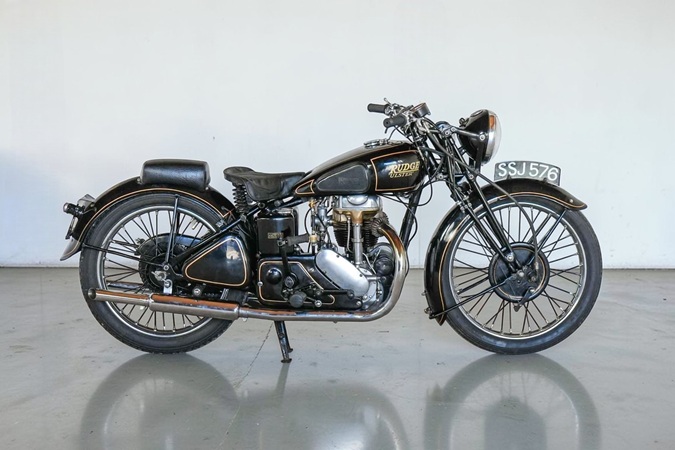
By the late 1930s, Rudge had further refined its competition machines, culminating in models such as the legendary 1937 Rudge Ulster, a machine closely associated with endurance racing success and high-speed reliability.
1894 - Rudge Cycle Company was founded in Coventry, England, originally producing bicycles before entering the motor industry.
1911 - Rudge introduced its first motorcycles, quickly establishing a reputation for advanced engineering and strong competition potential.
1910s - The brand developed early racing success, focusing on lightweight construction and efficient single-cylinder engines.
1920s - Rudge became a major force in British motorcycle racing, especially in TT competition, with continual engineering refinement.
1924 - The introduction of the Rudge Four-Valve engine marked a major breakthrough in performance engineering for production motorcycles.
1930s - Rudge motorcycles achieved significant racing success, known for advanced valve technology, strong braking systems, and high-speed stability.
1930-1939 - The company won multiple Isle of Man TT races, solidifying its reputation as one of Britain's top performance manufacturers.
1938 - Rudge was acquired by the N. S. U. (NSU) alliance interests and became part of a broader industrial consolidation trend in Europe.
1940-1945 - World War II halted civilian motorcycle development, with limited production focused on wartime requirements.
Post-1945 - Rudge motorcycles were no longer produced as an independent brand, but their engineering influence remained significant in British design.
Modern Era - Rudge is remembered for pioneering four-valve engine technology, TT racing dominance, and its contribution to early high-performance motorcycle engineering.
Rudge motorcycles are regarded as highly specialized collector pieces, particularly valued for their racing pedigree and engineering originality rather than production volume.
Unlike mass-market British manufacturers, surviving Rudge machines are significantly rarer, with many examples having been lost to racing wear or mechanical modification over time.
Authentic, numbers-matching machines with documented provenance are considered top-tier acquisitions within pre-war British motorcycle collecting.
Key collector examples include the 1930 Rudge Model 350 Radial, a landmark in early engine innovation featuring radial valve architecture, and the 1937 Rudge Ulster, a machine synonymous with endurance racing performance and engineering refinement.
Additional rare British performance motorcycles can be explored through our global vintage motorcycle archive, featuring collector-grade machines across multiple eras and manufacturers.
Rudge is historically significant not because of production scale, but because of its direct influence on racing motorcycle engineering principles.
Its innovations in combustion efficiency and lightweight chassis construction contributed to the broader evolution of competitive motorcycle design in Europe.
For historians, Rudge represents a transitional point between early mechanical experimentation and modern performance engineering logic.
Rudge motorcycles are considered high-tier niche collector assets, primarily valued by specialists focused on racing heritage and engineering innovation.
Due to extremely limited survival rates and strong historical significance, well-preserved examples are rarely available on the open market.
As interest in pre-war racing motorcycles continues to grow, models such as the Ulster and radial-engine variants are increasingly recognized as blue-chip heritage machines.
When acquiring a Rudge motorcycle, verification of originality is critical, particularly regarding engine configuration, radial head authenticity, and frame-number matching.
Competition-used machines require additional historical validation, as racing modifications were common during the period and can significantly affect collector value.
Each Rudge motorcycle in our collection is assessed to museum-grade standards, ensuring authenticity, provenance documentation, and mechanical integrity.
Below is a curated selection of collector-grade Rudge motorcycles available for acquisition. Each machine is verified, historically documented, and prepared for international collector transfer.
We offer Rudge vintage motorcycles for sale to collectors worldwide, including the United Kingdom, Europe, United States, Australia, and Asia. All machines are securely exported with full documentation, insurance coverage, and professional crating services.
Pricing is determined by rarity, originality, and historical competition provenance. Please contact us for current availability and acquisition details.
Contact our specialists for availability, pricing, and international shipping arrangements. Request Availability

The Rudge marque occupies a critical position in the development of performance-oriented British motorcycles, particularly during the interwar years when racing success and engineering experimentation began to redefine the industry. Its legacy is best understood within the broader context of pre-war motorcycle engineering (1900-1939) , where rapid innovation transformed motorcycles from basic transport machines into highly specialized performance vehicles.
By the 1930s, manufacturers such as Rudge were no longer competing solely on reliability, but on measurable racing performance and mechanical efficiency. This shift forms part of the wider evolution documented in post-war British motorcycle development (1945-1969) , where many engineering principles pioneered in the pre-war racing era were further refined and standardized.
For collectors comparing engineering approaches across manufacturers, a broader perspective can be gained through global vintage motorcycle collections and archival listings , where racing-oriented marques such as Rudge can be evaluated alongside touring and mass-production counterparts.
Which Rudge motorcycles are considered historically important?
Models such as the Rudge Ulster series and radial-engine variants are widely regarded as defining milestones, representing the brand's success in competition and its contribution to advanced combustion and cylinder head design.
What makes Rudge motorcycles collectible today?
Their value is closely tied to racing pedigree, engineering originality, and limited survival rates. Many Rudge motorcycles were used in competition, which significantly reduced the number of intact, original examples available today.
How are Rudge motorcycles typically acquired?
Surviving machines are usually sourced through specialist collectors and curated networks, where historical documentation and mechanical authenticity are essential to verifying provenance.
Do Rudge motorcycles hold long-term value?
High-quality examples, particularly competition-associated machines such as the Ulster, continue to attract strong interest due to their historical importance and technical innovation within pre-war motorcycling.
Rudge's historical importance becomes clearer when viewed through the lens of competitive engineering development, where innovation was often driven by racing requirements rather than commercial demand. This perspective is explored further in studies of early performance-focused motorcycle engineering , particularly in relation to combustion efficiency and lightweight chassis design.
Rather than following mass-production trends, Rudge contributed to a more specialized engineering narrative, making it a key reference point in the study of racing motorcycle evolution.
The development of Rudge motorcycles reflects a broader industrial shift in which engineering firms began prioritizing performance metrics derived from competition. This transition is documented within the wider history of British motorcycle brands , where Rudge is frequently recognized for its technical innovation rather than production scale.
Within the collector market, Rudge motorcycles occupy a highly specialized segment defined by racing history and technical innovation. Their valuation is often influenced by competition provenance, originality of engine configuration, and overall preservation condition.
These dynamics align with broader trends outlined in global vintage motorcycle market analysis , where historically significant machines with limited survival rates consistently outperform more common production models.
Rudge's engineering identity is defined by its pursuit of performance efficiency, particularly through innovations such as the radial four-valve cylinder head. These developments allowed for improved airflow and combustion, giving Rudge a competitive advantage in racing environments.
This engineering approach can be better understood through comparative analysis such as British versus German motorcycle engineering philosophies , where different national approaches to performance and design become evident.
Explore our complete library of buyer advice and workshop insights, featuring international logistics FAQs, model-specific troubleshooting, common vintage bike problems, and step-by-step restoration methods: