
The Vintage Motorcycles
Specialists in antique, classic, veteran and vintage motorcycles.
Specialists in antique, classic, veteran and vintage motorcycles.
A curated collector-grade selection of Ducati motorcycles, representing one of the most influential manufacturers in the history of Italian sporting motorcycle engineering. From the legendary Imola racing program to the development of production Super Sport motorcycles, Ducati established a distinctive identity through lightweight chassis design, high-performance L-twin engines, desmodromic valve technology, and direct competition-derived engineering.
Curated by European vintage motorcycle specialists with extensive experience in sourcing historically significant Italian machines. Each Ducati motorcycle is selected with attention to provenance, originality, mechanical authenticity, and historically correct specification.
Ducati motorcycles occupy a distinctive position within the history of Italian motorcycle engineering, where racing development, mechanical innovation, lightweight chassis design, and industrial styling developed together to create some of the world's most recognizable sporting motorcycles.
Within the broader context of post-war motorcycle development (1945-1970s), Ducati evolved from a manufacturer of lightweight single-cylinder motorcycles into an internationally recognized sporting marque, eventually establishing its reputation through advanced twin-cylinder engines, desmodromic valve technology, and a close relationship between competition motorcycles and production machines.
Ducati's motorcycle development reflects a continuous evolution from lightweight post-war machines to increasingly sophisticated sporting, touring, and performance motorcycles. Across different generations, the company developed a distinctive engineering philosophy combining compact engine architecture, lightweight chassis design, advanced valve-control systems, and a close relationship between road motorcycles and competition development.
During the post-war period, Ducati established its motorcycle identity through lightweight single-cylinder machines, progressively developing larger-capacity engines and more advanced chassis configurations. The work of engineer Fabio Taglioni became particularly influential, with desmodromic valve control and bevel-driven overhead camshaft systems becoming important elements of Ducati's technical identity.
During the late 1960s and early 1970s, Ducati expanded into larger-capacity twin-cylinder motorcycles, introducing the 90-degree V-twin architecture that would become one of the defining characteristics of the marque. The Ducati 750 GT marked an important step in this transition, followed by increasingly performance-oriented models developed for both road use and competition.
Ducati's racing program played an important role in this engineering evolution. Competition motorcycles provided a testing ground for engine development, chassis design, braking systems, weight reduction, and high-speed stability, while successful technical solutions were subsequently adapted for production motorcycles.
The 1974 Ducati 750 Super Sport represents one significant milestone within this broader development. Its 748 cc 90-degree L-twin, desmodromic valve control, bevel-driven overhead camshafts, five-speed transmission, and lightweight sporting chassis reflected Ducati's increasingly direct connection between competition engineering and road-going performance motorcycles.
The 750 Super Sport also demonstrated how Ducati's success at the 1972 Imola 200 Miles influenced the development of production motorcycles. Rather than representing an isolated model, the 750SS formed part of a wider engineering progression that connected Ducati's early single-cylinder machines, the development of its V-twin architecture, the evolution of desmodromic technology, and the company's continuing pursuit of racing-derived performance.
Through subsequent decades, Ducati continued to expand and refine this engineering philosophy across multiple motorcycle categories and generations. The company's history therefore encompasses lightweight singles, V-twin and later twin-cylinder platforms, Super Sport motorcycles, sporting road machines, sport-tourers, naked motorcycles, and dedicated superbikes, with racing technology continuing to influence production design.
This broader production and engineering evolution is central to understanding Ducati as a motorcycle manufacturer: a marque whose identity has been shaped not by a single model, but by the continuous interaction between Italian design, mechanical experimentation, competition development, and high-performance road motorcycle engineering.
1926 - Ducati was founded in Bologna, Italy, establishing the industrial company that would later become one of Italy's most recognizable motorcycle manufacturers.
1946 - Ducati entered motorcycle production with the Cucciolo, marking the beginning of its motorcycle manufacturing history.
1950s - Ducati developed increasingly sophisticated single-cylinder motorcycles and established a growing reputation for lightweight performance and engineering innovation.
1956 - Fabio Taglioni joined Ducati and became one of the most influential engineers in the company's motorcycle history.
1960s - Ducati expanded its sporting range and developed increasingly advanced single-cylinder desmodromic engines.
1971 - The Ducati 750 GT introduced the company's new 90-degree V-twin architecture designed under Fabio Taglioni.
1972 - Paul Smart and Bruno Spaggiari finished first and second at the Imola 200 Miles on Ducati's 750 Imola racing machines, establishing a defining moment in Ducati's sporting history.
1973 - Ducati presented the 750 Super Sport Desmo at the Milan Motorcycle Show, bringing racing-derived desmodromic technology into a production sporting motorcycle.
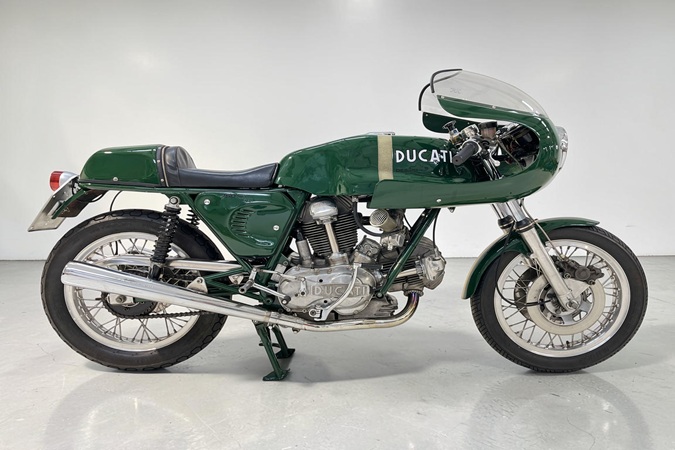
1974 - The 750 Super Sport entered production, becoming one of Ducati's most historically significant early Super Sport motorcycles and the basis for the famous round-case "Green Frame" machines.
1975 - Ducati continued developing its large-capacity Super Sport platform, expanding the engineering concepts established by the 750 SS.
1977 - Cook Neilson won the Daytona 200 on a Ducati 750 SS, further strengthening the model's international racing legacy.
1978 - Mike Hailwood won the Isle of Man TT Formula One race on Ducati, adding another defining achievement to the marque's sporting history.
1980s - Ducati continued developing high-performance twin-cylinder motorcycles while refining its chassis and engine technology.
1990s - The Ducati Superbike program became internationally dominant, further establishing the brand's connection between racing technology and production motorcycles.
Modern Era - Ducati continues to develop high-performance motorcycles while maintaining the engineering and design heritage established through its historic racing and road-going machines.
Ducati occupies a distinctive position within the vintage motorcycle market, where racing history, engineering innovation, limited production, and originality are important considerations when evaluating historically significant examples.
The early 1970s 750 Super Sport is particularly important because it represents the transition from Ducati's successful Imola racing program into a production motorcycle. The 1974 version combined a 748 cc L-twin, desmodromic valve control, bevel-driven camshafts, fiberglass bodywork, and a lightweight sporting chassis.
The original 1974 production run was extremely limited, with historical references generally identifying approximately 401 examples. This limited production, combined with subsequent racing use and modification of many surviving motorcycles, makes originality and provenance important considerations when assessing an individual example.
For a broader comparative perspective, collectors can explore global vintage motorcycle inventory archives, where Ducati motorcycles can be considered alongside other historically significant Italian, British, German, American, and European machines.
The 1974 Ducati 750 Super Sport is one of the most historically significant motorcycles from Ducati's early large-capacity twin-cylinder era. It represents the point at which Ducati's developing sporting-engineering philosophy, Italian design, and competition experience converged in a limited-production road motorcycle.
At the center of the 750 Super Sport is a 748 cc air-cooled 90-degree L-twin engine, featuring bevel-driven overhead camshafts and Ducati's desmodromic valve-control system. The engine is paired with a five-speed transmission and twin Dell'Orto carburetors, while the tubular steel chassis and sporting suspension configuration reflect the motorcycle's performance-oriented design.
The 750SS is also distinguished by its period-specific construction and visual identity. The combination of silver fiberglass bodywork, blue-green frame, distinctive fuel-tank design, and high-mounted exhaust system became closely associated with the early "Green Frame" Ducati Super Sport motorcycles. These details are an important part of the model's historical identity and are relevant when evaluating originality and restoration quality.
According to Ducati's historical heritage specifications, the 750 Super Sport Desmo was equipped with a 748 cc engine producing 72 hp at 9,500 rpm, with a claimed maximum speed of 220 km/h and a dry weight of 187 kg. These specifications illustrate the performance-oriented engineering direction Ducati pursued during the early 1970s.
The Ducati 750 Super Sport occupies an important position in the development of Ducati's sporting motorcycles because it brought together several engineering themes that would remain central to the marque: the 90-degree L-twin configuration, desmodromic valve control, bevel-driven camshafts, lightweight construction, and competition-informed chassis development.
Its historical context is closely connected with Ducati's 750 Imola racing program. The first-place finish of Paul Smart and the second-place finish of Bruno Spaggiari at the 1972 Imola 200 Miles demonstrated the potential of Ducati's new twin-cylinder platform and helped establish the technical and sporting foundation from which the production Super Sport evolved.
The 750SS therefore represents more than a single high-performance motorcycle. It illustrates a significant period in European motorcycle development, when manufacturers increasingly transferred technology and engineering concepts developed through competition into limited-production road motorcycles.
The model also occupies a distinct place within Ducati's broader Super Sport lineage. Its early round-case architecture, limited production, desmodromic engine technology, and distinctive "Green Frame" specification differentiate the 1974 750SS from the larger-capacity and later-generation Ducati Super Sport motorcycles that followed.
For collectors, the importance of the 750SS extends beyond performance specifications. Originality, correct period components, engine and frame identification, bodywork, mechanical configuration, and documented provenance all contribute to understanding the historical significance of an individual surviving example.
The collector significance of a vintage Ducati is shaped by several interconnected factors, including production history, model rarity, mechanical originality, correct specification, documented provenance, and the quality and extent of any restoration work. Different Ducati models occupy different positions within the collector market, making individual assessment particularly important when evaluating historically significant examples.
For earlier and limited-production Ducati motorcycles, collectors commonly pay close attention to the authenticity of the engine and frame, original or period-correct components, factory specification, bodywork, mechanical configuration, instrumentation, and other details specific to the model and production period. The importance of individual components can vary considerably between different Ducati generations.
The 1974 Ducati 750 Super Sport provides a particularly clear example of this principle. Its round-case 748 cc L-twin engine, desmodromic valve system, bevel-driven camshafts, distinctive fiberglass bodywork, and period-specific chassis components are all relevant when assessing the historical authenticity of an individual motorcycle.
Restoration should therefore be considered separately from originality. A professionally restored motorcycle can preserve and return an important historic machine to operational condition, while replacement, reproduction, or later components may nevertheless affect its originality and historical configuration. For this reason, a meaningful collector evaluation should consider the motorcycle's mechanical condition, structural integrity, restoration history, historical specification, and available documentation together.
Where available, ownership records, period photographs, factory or period documentation, service history, matching engine and frame identification, and other provenance evidence can provide valuable context when establishing the history of a surviving Ducati motorcycle. Such documentation can also help distinguish between a historically preserved example, a sympathetically restored machine, and a motorcycle that has undergone substantial modification over its lifetime.
For collectors, the value of Ducati heritage ultimately extends beyond rarity alone. The combination of engineering significance, competition history, production characteristics, originality, provenance, condition, and the ability to document an individual motorcycle's identity and history provides a more complete basis for understanding its place within Ducati's broader legacy.
When acquiring a historically significant Ducati, collectors should prioritize authenticity, correct model specification, frame and engine identification, original mechanical architecture, and documented provenance.
For a 1974 750 Super Sport, particular attention should be paid to the round-case 748 cc L-twin engine, bevel-driven camshaft system, desmodromic valve train, fiberglass bodywork, fuel tank, frame construction, carburetors, exhaust system, wheels, brakes, and period-correct chassis components.
Restoration quality should also be evaluated carefully. A motorcycle may be mechanically restored to a high standard while containing reproduction, replacement, or later components. For collector purposes, the distinction between mechanical restoration and historical originality should therefore always be documented clearly.
Each Ducati motorcycle in our collection is evaluated with attention to historical authenticity, mechanical integrity, condition, and collector relevance.
Our current Ducati collection includes a highly significant 1974 Ducati 750 Super Sport, representing one of the most important early chapters in Ducati's Super Sport and superbike history. The motorcycle is presented as a collector-grade example with restoration, mechanical, and identification details available for serious buyers.
We offer Ducati vintage motorcycles to collectors worldwide, including Europe, the United States, Australia, and Asia. Each motorcycle is professionally prepared for international export, with insured shipping, professional crating, and export documentation support.
Availability and pricing depend on rarity, condition, originality, provenance, and historical significance. Please contact us for current acquisition details and documentation.
Contact our specialists for availability, detailed specifications, originality information, restoration details, provenance, and international shipping options. Request Availability
Post-War Motorcycle Development (1945-1970s) - Ducati's transformation from lightweight post-war motorcycle production into a major Italian sporting manufacturer, including the development of sophisticated single-cylinder engines, desmodromic valve technology, and larger-capacity twin-cylinder motorcycles.
Italian Racing Motorcycle Development - Explore the competition environment that shaped Ducati's engineering philosophy, including the transfer of racing technology into road-going motorcycles and the development of production-derived sporting machines.
Browse the full vintage motorcycle inventory worldwide, including Ducati and other historically significant Italian, British, German, American, and European motorcycles.
What makes Ducati motorcycles historically significant?
Ducati is recognized for the close relationship between racing development and production motorcycles,
with major engineering milestones including desmodromic valve technology,
90-degree L-twin engines,
lightweight chassis design,
and competition-derived sporting motorcycles.
Why is the 1974 Ducati 750SS important?
The 1974 Ducati 750 Super Sport represents the production development of Ducati's successful 750 Imola racing program.
It combines a 748 cc L-twin,
desmodromic valve control,
bevel-driven camshafts,
sporting chassis engineering,
and distinctive fiberglass bodywork.
How many 1974 Ducati 750SS motorcycles were produced?
Historical references generally identify approximately 401 examples produced during 1974.
The limited production run,
combined with subsequent racing use and modification,
makes surviving examples particularly important to authenticate carefully.
What is the Ducati 750SS Green Frame?
The term "Green Frame" commonly refers to the distinctive blue-green frame finish associated with the early round-case Ducati 750 Super Sport,
particularly the 1974 production machines.
The silver fiberglass bodywork and blue-green frame became one of the most recognizable visual combinations in Ducati history.
What should collectors check when buying a Ducati 750SS?
Collectors should examine the engine and frame identification,
desmodromic valve train,
round-case engine configuration,
fiberglass fuel tank and bodywork,
carburetors,
exhaust system,
wheels,
brakes,
suspension,
electrical equipment,
period components,
restoration history,
and available provenance documentation.
Do you provide international shipping for classic Ducati motorcycles?
Yes.
We provide international export support,
professional crating,
insured shipping,
and door-to-door delivery options for collectors worldwide.
For collectors and researchers, Ducati represents one of the most important developments in Italian sporting motorcycle engineering. The marque's history connects competition success, desmodromic engine development, lightweight chassis engineering, and distinctive Italian industrial design.
Understanding provenance, mechanical originality, model lineage, and restoration quality is particularly important when evaluating historically significant Ducati motorcycles. The following resources provide broader context for collectors researching Italian motorcycle history, market trends, restoration, and acquisition.
Explore Ducati within the broader context of Italian industrial, engineering, and racing history, where competition development and road motorcycle technology evolved closely together:
Understanding the vintage Ducati market requires consideration of production rarity, historical importance, originality, provenance, restoration quality, and the condition of surviving mechanical components. Early Super Sport motorcycles with strong historical documentation can occupy an important position within the market for collectible Italian motorcycles.
Ducati engineering is strongly associated with the development of high-performance twin-cylinder motorcycles, desmodromic valve technology, bevel-driven camshaft systems, lightweight chassis architecture, and the transfer of racing technology into production motorcycles.
The 1974 750 Super Sport provides a particularly clear example of this engineering philosophy. Its 748 cc air-cooled L-twin, desmodromic valve train, bevel-driven overhead camshafts, five-speed transmission, Marzocchi suspension, and racing-derived chassis demonstrate the technical direction Ducati pursued during the early 1970s.
Delve into crucial buyer information and hands-on mechanical guides, covering cross-border sales, classic motorcycle maintenance, mechanical troubleshooting, historical authentication, restoration practices, and our collector motorcycle preservation philosophy: