
The Vintage Motorcycles
Specialists in antique, classic, veteran and vintage motorcycles.
Specialists in antique, classic, veteran and vintage motorcycles.
A curated museum-grade selection of Victoria motorcycles, representing one of Germany's most historically significant early motorcycle manufacturers. Founded in Nuremberg, Victoria-Werke AG developed machines that emphasized lightweight construction, mechanical efficiency, and early adoption of advanced 2-stroke engineering solutions, positioning the brand as a key contributor to Germany's commuter motorcycle evolution.
Curated by European vintage motorcycle specialists with deep expertise in early German engineering and lightweight motorcycle manufacturers. Each Victoria motorcycle is selected based on originality, mechanical authenticity, and historical relevance within pre-war industrial development.
Victoria-Werke AG represents a defining chapter in early German motorcycle engineering, where industrial precision met lightweight mechanical design to create practical and efficient motorcycles for civilian use. Operating from Nuremberg, Victoria became known for its early adoption of 2-stroke technology and its focus on accessible transportation solutions during the formative years of European motorcycling.
Within the broader framework of pre-war motorcycle development (1900-1939), Victoria reflects a distinctly German engineering philosophy, where functional efficiency, mechanical reliability, and compact design were prioritized over large-displacement performance engineering.
Victoria motorcycles were developed during a period of rapid industrial standardization in Germany, where manufacturers were increasingly focused on producing lightweight and economically viable transportation solutions. Rather than pursuing heavy touring or performance-focused machines, Victoria specialized in compact commuter motorcycles designed for urban mobility.
A defining characteristic of the brand was its early experimentation with 2-stroke engine architecture, which allowed for simplified mechanical construction, reduced manufacturing cost, and improved usability for everyday riders.
This engineering direction placed Victoria among key German manufacturers contributing to the evolution of small-capacity motorcycle design, alongside broader European industrial developments documented in motorcycle manufacturers by country.
This evolution can also be contextualized within post-war motorcycle development, where lightweight commuter motorcycles became central to European mobility reconstruction and economic recovery.
1886 - Victoria Fahrradwerke was founded in Nuremberg, Germany, originally producing bicycles and precision mechanical components.
1901 - The company entered the motorcycle industry, becoming one of the early German manufacturers of motorized bicycles.
1910s - Victoria expanded its motorcycle range with lightweight single-cylinder machines focused on practical transportation and reliability.
1914-1918 - During World War I, production was partially redirected toward military supply and industrial manufacturing needs.
1920s - The brand gained recognition for efficient commuter motorcycles and early adoption of improved engine designs in the German market.
1930s - Victoria introduced more advanced engineering, including refined two-stroke and four-stroke engines, along with improved chassis design.
1938 - The Victoria KR series development began, laying the foundation for one of its most famous lightweight motorcycle families.
1940-1945 - World War II disrupted civilian production, with industrial facilities impacted by wartime demands and restrictions.
Post-1945 - Victoria resumed motorcycle production in Germany, focusing on economical and practical transport solutions for post-war recovery.
1950s - The KR 25 and KR 26 models became highly popular, known for their lightweight design, reliability, and fuel efficiency.
1960s - Competition from larger manufacturers and changing market conditions led to declining motorcycle production and reduced brand presence.
1979 - Victoria motorcycle production effectively ended, closing a long chapter of German lightweight engineering history.
Modern Era - Victoria is remembered for its role in early German motorcycling, especially its efficient commuter motorcycles and KR series lightweight engineering philosophy.
Victoria motorcycles occupy a respected niche within the vintage German motorcycle market, valued primarily for their engineering efficiency, historical relevance, and early adoption of 2-stroke technology.
Unlike high-performance marques, Victoria's significance lies in its role in shaping accessible transportation systems in early 20th-century Germany.
For comparative research, collectors often reference global vintage motorcycle inventory archives, where Victoria machines can be contextualized alongside other German manufacturers such as DKW, NSU, and Adler.
Within Victoria-Werke AG's historical lineup, the brand's engineering development can be understood through a progression of lightweight and mid-capacity motorcycles that reflect evolving German design priorities from the pre-war to early post-war periods. Early 125cc models established Victoria's foundation in compact commuter engineering, focusing on accessibility, fuel efficiency, and reliable everyday usability for urban riders.
The 350cc Touring Motorcycles represent the brand's expansion into more versatile mid-range machines, balancing practicality with improved endurance for longer-distance road use. Building on this foundation, the 500cc Touring Models marked a further step toward increased displacement and stability, offering more capable touring performance while maintaining Victoria's core philosophy of mechanical efficiency and controlled simplicity.
In the higher-performance segment, the KR 6 and KR 20 models demonstrate Victoria's engagement with advanced engineering concepts, including refined chassis dynamics and more performance-oriented road behavior, positioning these motorcycles closer to sporting and competitive applications within the German market context of the era.
The V35 Bergmeister stands as the most technically advanced expression of the brand's engineering identity, representing a mature integration of V-twin architecture, touring capability, and high-speed stability, often regarded as Victoria's flagship achievement in pre-war motorcycle development.
Overall, Victoria's model range illustrates a coherent evolution from lightweight commuter machines to more sophisticated touring and performance-oriented motorcycles, reflecting broader trends in German motorcycle engineering focused on precision, efficiency, and progressive mechanical refinement.
Victoria represents a foundational example of German lightweight motorcycle engineering, where efficiency and practicality were prioritized over performance extremes.
Its historical importance lies in demonstrating how early German manufacturers contributed to the democratization of motorcycle ownership through compact, affordable, and mechanically efficient designs.
This positions Victoria as a key reference in studies of motorcycle engineering evolution and industrial design progression.
Vintage Victoria motorcycles are considered historically significant due to their early role in German lightweight motorcycle development and their limited survival rate in original condition.
Collector value is driven primarily by originality, engineering authenticity, and historical relevance rather than performance specifications.
As interest in early European commuter motorcycles grows, Victoria is increasingly recognized as an important contributor to pre-war German industrial mobility history.
When acquiring a Victoria motorcycle, collectors should prioritize originality, correct period specification, and mechanical authenticity due to varying production documentation across early models.
Each motorcycle in our collection is carefully evaluated for historical accuracy and preservation quality, ensuring alignment with original German engineering standards.
Below is a curated selection of collector-grade Victoria motorcycles available for acquisition. Each machine is verified, documented, and presented within its historical engineering context.
We offer Victoria vintage motorcycles for collectors worldwide, with professional crating, insurance, and full export documentation.
Availability is limited due to rarity and historical significance. Please contact us for current acquisition opportunities.
Contact our specialists for availability, provenance details, and international shipping options. Request Availability
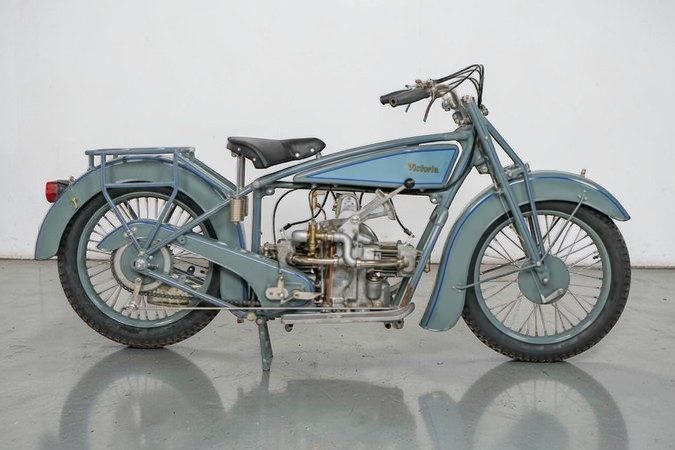
The historical position of Victoria-Werke AG is best understood within the broader evolution of early German motorcycling, particularly during the formative decades of pre-war motorcycle engineering between 1900 and 1939. This period marked the transition from experimental, bicycle-derived machines to purpose-built motorcycles engineered around efficiency, structural refinement, and increasingly systematic industrial production. Within this context, Victoria emerged in Germany as a manufacturer that developed a broad spectrum of motorcycles, ranging from lightweight commuter models to more advanced touring and performance-oriented machines.
Unlike brands focused solely on either utilitarian transport or racing specialization, Victoria developed a diversified engineering identity, reflected across its model range from 125cc commuter motorcycles through 350cc and 500cc touring platforms, as well as more advanced performance machines such as the KR series and the V35 Bergmeister. This progression illustrates how the brand balanced practical usability with increasing technical sophistication, particularly in mid-capacity and touring-oriented configurations.
Early models such as the 125cc range and 350cc Touring Motorcycles highlight Victoria's foundation in accessible, efficiency-driven engineering, where reliability and ease of maintenance were central design priorities. The 500cc Touring Models represent a natural evolution toward greater stability and long-distance capability, aligning with broader German engineering trends of the pre-war era that emphasized structured mechanical refinement over experimental complexity.
In contrast, higher-performance developments such as the KR 6 and KR 20 demonstrate Victoria's engagement with more advanced chassis dynamics and sport-influenced engineering, reflecting the growing demand for faster, more responsive road motorcycles in the late pre-war period. At the top of the range, the V35 Bergmeister stands as the most sophisticated expression of the brand's engineering philosophy, integrating V-twin architecture with touring endurance and high-speed stability in a highly refined pre-war design.
Within the broader European transition toward industrial standardization following the Second World War, as outlined in studies of post-war motorcycle development, Victoria motorcycles are primarily evaluated today through both their pre-war engineering diversity and their contribution to the evolution of mid-capacity and touring motorcycle design in Germany. The brand's ability to span multiple displacement classes places it in a unique position within early European motorcycle history.
For collectors and researchers, Victoria motorcycles are typically analyzed within a comparative framework alongside other major German manufacturers. This perspective is reflected in global vintage motorcycle inventory archives, where Victoria can be contextualized alongside brands such as BMW, DKW, NSU, and Adler, highlighting differences in engineering philosophy ranging from lightweight commuter design to advanced touring and performance systems within early German mobility development.
What defines the historical importance of Victoria motorcycles?
Victoria is recognized for its wide engineering spectrum, spanning lightweight commuter motorcycles, mid-capacity touring machines, and advanced performance models such as the KR series and V35 Bergmeister, reflecting a uniquely diverse German motorcycle manufacturer profile.
Are Victoria motorcycles rare today?
Yes. While some post-war models survive in moderate numbers, pre-war performance and high-spec touring models - particularly KR and V35 variants - are increasingly rare, especially in original and well-preserved condition.
Which Victoria models are most significant to collectors?
Collector interest typically focuses on the KR 6, KR 20, and V35 Bergmeister for their engineering sophistication, along with earlier 350cc and 500cc Touring Models that represent the brand's foundational development phase.
Do Victoria motorcycles hold long-term collector value?
Well-preserved Victoria motorcycles are increasingly valued for their technical diversity and historical significance, particularly as examples of Germany's multi-segment motorcycle engineering approach during the pre-war and early post-war eras.
Victoria occupies a distinctive position within early German motorcycle development, defined by its unusually broad engineering range that spans from lightweight commuter machines to advanced touring and performance platforms. Early 125cc and 350cc models demonstrate the brand's foundation in accessible, efficiency-driven engineering, while larger 500cc Touring Models reflect a progression toward stability and long-distance capability. At the higher end, performance-oriented machines such as the KR series and V35 Bergmeister illustrate a clear engagement with more advanced mechanical architecture and sport-influenced design principles.
Understanding Victoria requires situating it within the wider context of European mechanical evolution, where manufacturers responded differently to industrial growth, urban mobility demands, and emerging performance expectations. In this sense, Victoria serves as a key reference point for studying how German manufacturers balanced multi-segment production strategies within a rapidly modernizing motorcycle industry.
The development of Victoria is closely tied to Germany's early industrial manufacturing landscape, where precision engineering and structured production systems shaped mechanical design across multiple sectors. This broader context can be explored through comparative studies of motorcycle manufacturers by country, highlighting how German engineering emphasized mechanical discipline, efficiency, and technical refinement compared to other European approaches.
Further technical insight can be found in studies of motorcycle engine evolution, which explains why single-cylinder and early multi-cylinder configurations coexisted in German motorcycle development, driven by different requirements for reliability, performance, and production scalability.
For a broader historical overview of Victoria's engineering development and its position within German motorcycle manufacturing, see Victoria-Werke AG historical overview. This study provides additional context on the brand's model diversification, technical progression, and its role within the wider landscape of pre-war and early post-war European motorcycle design.
Within the vintage motorcycle market, Victoria occupies a complex position defined by both diversity and technical depth, where collector value is influenced by model rarity, engineering significance, and originality rather than uniform brand identity. This aligns with broader observations in vintage motorcycle market trend analysis, which highlights growing interest in manufacturers that demonstrate multi-layered engineering evolution rather than single-model fame.
As a result, Victoria motorcycles are increasingly evaluated not only as collectible machines, but also as historical artifacts representing Germany's multi-directional approach to motorcycle engineering, spanning commuter, touring, and performance categories.
Victoria engineering is defined by its structural diversity and progressive adaptation across multiple motorcycle segments. Rather than specializing in a single category, the brand developed a layered product range that balanced efficiency, durability, touring capability, and performance innovation. This approach reflects a broader German engineering philosophy where systematic refinement and category diversification often shaped long-term industrial success.
For deeper historical context, this development can be connected to the foundations outlined in pre-war motorcycle engineering history, as well as transitional analysis in pre-war versus post-war motorcycle design evolution, where shifting industrial demands led to increasing standardization across European motorcycle production systems.
Examine exhaustive buying tutorials combined with advanced mechanical insights, such as international purchasing FAQs, brand-tailored troubleshooting, classic bike common faults, and workshop rebuild steps: